How Much Does RentCafe API Integration Cost?
Imagine you ask three developers for a quote and get three very different answers, with no way to tell why. That is therefore the usual starting point for RentCafe API integration cost. However, the price is not one number, because it combines Yardi access, development, design and upkeep. So this guide is for property managers, marketing managers and operators who are budgeting a RentCafe-connected website. It breaks the cost into layers, so you can budget properly and compare quotes fairly.
Short answer: We can’t give an honest single price, because no source we found lists one. However, you can predict where the money goes: access, build, design, testing and ongoing monitoring. Then ask for written quotes that separate those layers, so you compare like with like.
How much does RentCafe API integration cost?
However, there is no single published price. RentCafe API integration cost depends on Yardi access terms, the data you display, your design, the number of properties and ongoing monitoring. We don’t publish a fixed price either, because scope varies too much. Budget by cost layer, then request written quotes.
RentCafe development cost also depends on what already exists. For example, a property with clean unit data and a standard layout is a smaller job than a portfolio with custom branding, several systems and lead handoff. So scope the data first, because it drives almost every other line.
What are the cost layers of a RentCafe integration?
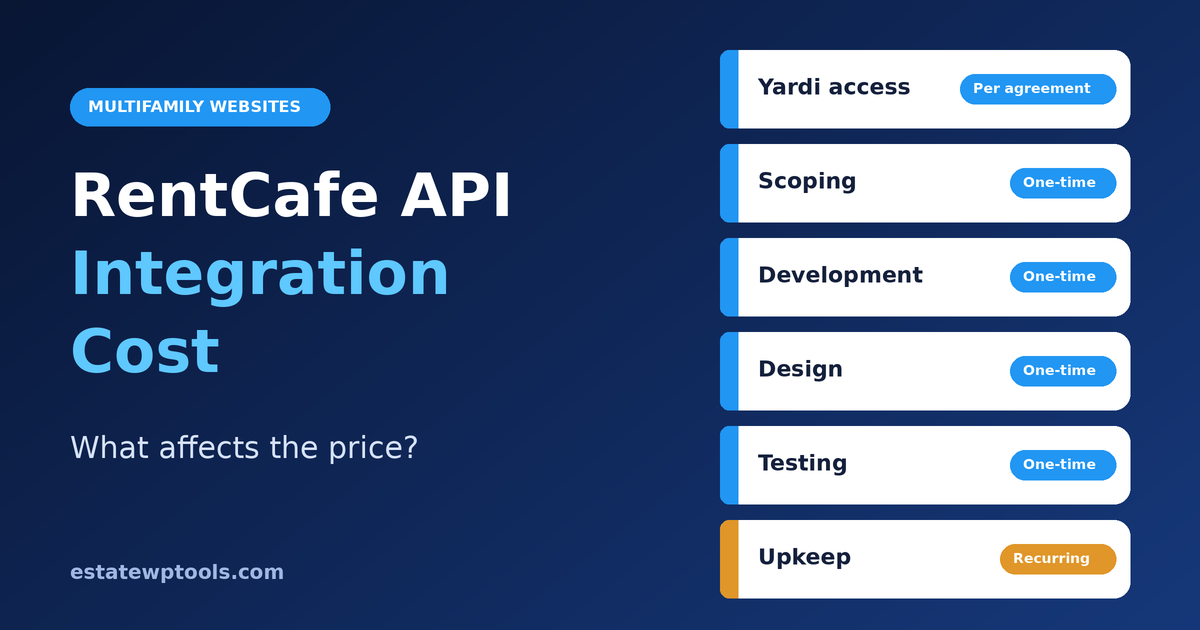
Think in six layers: Yardi access, scoping, development, design, testing and upkeep. The first five are mostly one-time, while upkeep repeats. Separating them in a quote shows exactly what you are paying for, so you can see where to reduce scope without hurting the result.
| Layer | One-time or recurring | What drives it |
|---|---|---|
| Yardi access and any fees | Depends on your agreement | Account type, who requests access, transaction terms |
| Scoping | One-time | Fields to display, number of properties |
| Development | One-time | Sync, storage, field mapping, caching |
| Design | One-time | Standard template or custom layout |
| Testing and launch | One-time | Pilot property, edge cases, fallbacks |
| Hosting, monitoring, fixes | Recurring | Sync frequency, alerts, changes at the source |
Does Yardi charge for RentCafe API access?
Possibly, but it depends on your agreement. Yardi’s APIv2 announcement describes transaction-based pricing with an annual cap, while a third-party review says vendors pay per-transaction fees. So ask Yardi in writing whether any charges apply to you, your developer or a connected vendor.
Access is also arranged through Yardi. For example, vendor setup guides describe requesting API credentials or enablement from a RentCafe representative. Therefore, start that conversation early, because waiting for access can delay the whole project.
What affects RentCafe developer cost?
RentCafe developer cost rises with data scope, the number of properties, design complexity and the number of connected systems, because each factor adds build and testing work. Messy unit data and unclear requirements, however, add testing time. Also, lead and tour handoff, fee display and several brands each add work. Therefore, simple, well-defined projects cost less.
| Project size | Typical scope | Relative effort |
|---|---|---|
| Simple | One property, floor plans and availability, standard template | Lower |
| Medium | Several properties, custom design, pricing display | Moderate |
| Complex | Large portfolio, CRM handoff, fees, multiple systems | Higher |
However, this table shows relative effort, not prices. Ask each developer to place your project in a row and explain why.
How do apartment website development cost and multifamily website cost fit in?
Integration is one line inside a wider budget, so separate it. Apartment website development cost usually also covers design, content, SEO, hosting and maintenance. Multifamily website cost then grows with each property and feature. Ask for the integration as a separate line, so you can compare quotes cleanly.
A quote that bundles everything into one number, for example, hides whether the sync is included. Instead, ask for the site build and the data integration separately, then compare each part.
Is a plugin cheaper than a custom integration?
A plugin usually costs less upfront and launches faster, but it limits design and data control. A custom integration, however, costs more to build and gives you control over layout, caching and lead handoff. So choose by design needs, portfolio size and who will maintain it.
Plugin sync features may also carry license costs, so check them. Meanwhile, a RentCafe-hosted website can need no integration at all, which avoids that line entirely. Also, our RentCafe API WordPress integration guide explains the build in more detail.
What mistakes make the cost rise?
Costs usually rise because scope is vague, access arrives late, nobody runs a pilot or design changes after development starts. Each mistake adds rework, because the sync, the mapping and the templates all depend on each other. Therefore, fix scope first, then build.
- Vague scope leads to extra fields and extra testing later, so define fields first.
- Late access stalls the build, so developers wait on credentials.
- No pilot means problems appear across every property at once, so pilot one property first.
- Late design changes force changes to templates and data mapping, so lock design early.
How does the integration affect lead capture and return?
Accurate data improves return because inquiry forms, tour scheduling and CRM handoff then work from real units and prices. Visitors choose what exists, so leasing teams spend less time on gone units. So the cost is easier to justify when the data supports leads, not only content.
Two illustrative scenarios, not client results. For example, a Chicago operator with several buildings may value consistent data across many small pages. Meanwhile, a Los Angeles operator with large communities may value fast, accurate availability for tour requests. In both cases, ask what the integration should improve, then measure it.
What ongoing costs should you expect?
Expect recurring costs for hosting, monitoring, fixes and changes at the source. Also, a sync can stall, a field can change or a floor plan can be renamed. Therefore, budget for monitoring and support, because an unmonitored integration quietly shows stale data. Finally, ask whether upkeep is a retainer, hourly or per fix.
How do you decide whether the cost is worth it?
Instead of guessing, compare the integration cost with what manual updates cost you today. Use this worksheet: weekly cost of manual updates = updates per week × minutes per update × places entered × hourly staff cost ÷ 60. Then compare it with the quote plus yearly upkeep.
Also remember the harder-to-measure cost, because wrong prices and phantom units lose leads. Also, for a deeper comparison, see our guide to RentCafe API vs manual property listings.
What should you ask for in a quote?
Ask for a written quote that lists what is included, what is excluded, who owns the code and how changes are handled. So a clear quote separates access help, development, design, testing and upkeep. Vague quotes hide risk, because missing items surface later as extra charges.
- Which properties and fields are in scope?
- Is help with Yardi access included?
- Is there a one-property pilot before full rollout?
- How is monitoring handled after launch?
- Who owns the code and the data mapping?
- How are changes priced after launch?
What affects the timeline?
Timeline also follows access approval, the number of properties, design complexity and data quality. Waiting for credentials is a common delay, so plan around it. Useful checkpoints: access confirmed, fields mapped, one-property pilot live, then full rollout. Also, our guide to floor plans, pricing and availability data helps you define the scope first.
When is a custom integration not worth the cost?
Skip it if you manage one small, stable community, if a RentCafe-hosted website already meets your needs, or if nobody will monitor the sync. In those cases, therefore, a simpler route costs less. However, custom work pays off mainly with several properties, frequent changes and a custom brand.
When should you hire a specialist?
Hire help when access, mapping and monitoring feel risky, or when your team lacks developers, because those areas cause most delays. A specialist can also scope the work before you commit, so the quote matches reality. If you manage Chicago properties, see our RentCafe API integration for Chicago property management websites.
Frequently asked questions
How much does RentCafe API integration cost?
There is no single published price, because cost depends on Yardi access terms, the fields you display, the number of properties, your design and ongoing monitoring. So ask for written quotes that separate access, build, design, testing and upkeep, then compare them like for like.
Does Yardi charge for RentCafe API access?
It depends on your agreement. Yardi’s APIv2 announcement describes transaction-based pricing with an annual cap, while a third-party review says vendors pay per-transaction fees. Therefore, ask Yardi in writing whether any charges apply to you, your developer or a connected vendor before you sign a project quote.
What affects RentCafe developer cost?
Data scope, the number of properties, design complexity and connected systems matter most. Messy unit data and unclear requirements, however, add testing time. Lead handoff and fee display also add work, so a well-defined project with a standard layout usually costs less than a custom portfolio-wide build.
Is a plugin cheaper than a custom RentCafe integration?
A plugin usually costs less upfront and launches faster, but it limits design and data control, and its sync features may carry license costs. A custom integration costs more to build, however, it gives you control over layout, caching and lead handoff. So choose by design needs and upkeep.
What is the apartment website development cost?
There is no standard figure. Apartment website development cost usually covers design, content, SEO, hosting and maintenance, and the integration is one line inside it. So ask for the site build and the data integration as separate lines, because that makes quotes comparable.
Are there ongoing costs after a RentCafe integration launches?
Yes. Expect hosting, monitoring, fixes and changes at the source, because a sync can stall or a field can change. Also ask whether upkeep is a retainer, hourly or per fix, since an unmonitored integration quietly shows stale prices and units.
How long does a RentCafe integration take?
It depends on access approval, the number of properties, design complexity and data quality. Waiting for credentials is a common delay. A one-property pilot is a sensible first milestone, because it exposes mapping problems before you roll out to the whole portfolio.
How can I compare quotes for a multifamily website?
Ask each provider to list what is included, what is excluded, who owns the code and how changes are priced. Then check that access help, development, design, testing and upkeep appear as separate lines. Multifamily website cost grows with each property, so confirm how many properties the quote covers.
Key takeaways
- There is no single price, so budget by cost layer.
- Also ask Yardi in writing whether any access fees apply.
- Compare quotes that separate access, build, design, testing and upkeep, so they match like for like.
- Budget for monitoring, because upkeep repeats.
- Then use the worksheet to compare against manual costs.
- Finally, start the access conversation early.