
Custom Chicago Property Search Website with RentCafe API
Finding an apartment in Chicago shouldn’t feel like searching through a spreadsheet.
But that’s still how many property websites feel. A visitor lands on the site, clicks around a few pages, struggles to find available units and eventually ends up on another apartment portal.
For property managers and multifamily companies, this is a missed opportunity.
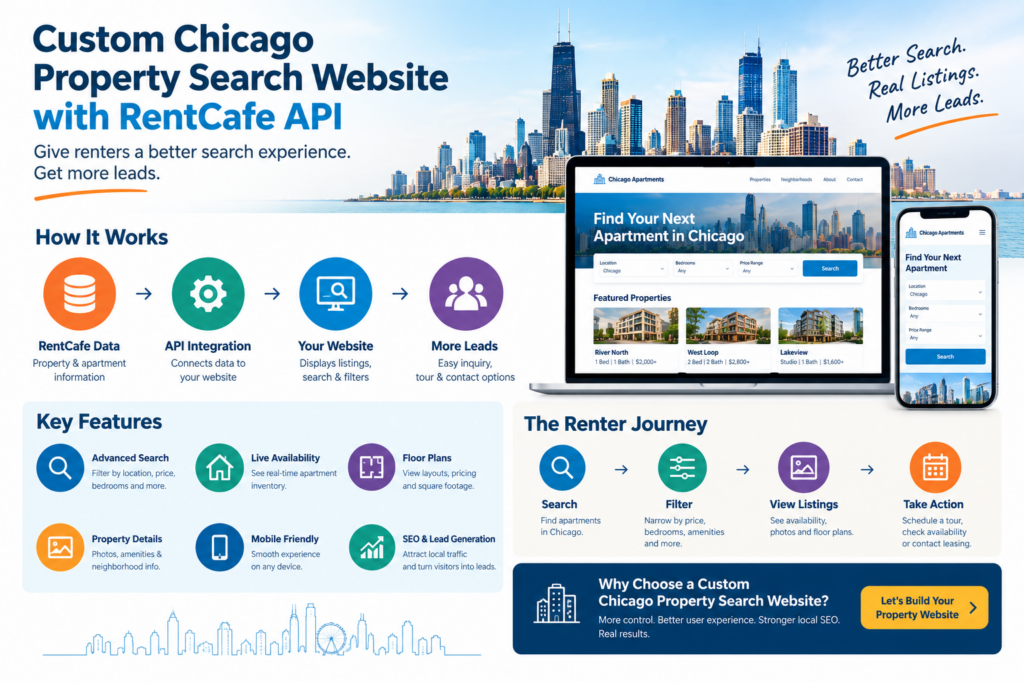
A well-designed Chicago property search website can give renters a much easier way to find apartments, compare floor plans, check availability and contact the leasing team. When combined with a RentCafe property search integration, the website can become much more than a collection of property pages. It can become a useful search and lead-generation platform.
This is especially valuable for Chicago property managers handling multiple communities across areas such as River North, West Loop, Lincoln Park, Lakeview, South Loop and Streeterville.
The idea is simple: bring property information into one easy-to-use website and make it much easier for renters to find what they’re looking for.
Why Build a Custom Chicago Property Search Website?
There are plenty of large apartment portals already available.
So why would a property management company invest in a custom search website?
Because your own website gives you control.
You control the design, branding, property content, SEO strategy, calls to action and the overall renter experience.
You also aren’t sending every visitor to a third-party marketplace where they can immediately start comparing your property with hundreds of competitors.
A custom property search website can be built around your specific portfolio.
For example, a renter could start by selecting:
Chicago → Neighborhood → Property → Apartment Type → Price → Availability
From there, they can view matching apartments and move directly toward an inquiry or tour request.
That is a much cleaner journey.
How RentCafe API Can Power Apartment Search
The technical side is where the RentCafe API can become useful.
Depending on the available RentCafe account and API/integration access, property and apartment information can be connected to a custom website.
The exact information available will depend on the integration, but the concept can include property information, apartment availability, floor plans and other relevant listing data.
A typical architecture might look like:
RentCafe → API → Website Database/Cache → Property Search → Apartment Details → Lead Form
The website doesn’t necessarily need to request fresh information from the API every time someone opens a page. Depending on the project, data can be synchronized or cached to help create a faster browsing experience.
This is one reason it’s important to work with a developer who understands both the API integration and the website experience.
Connecting the data is only the beginning.
What Makes a Good RentCafe Property Search Experience?
A RentCafe property search should be designed around the renter.
That sounds obvious, but it gets missed surprisingly often.
A renter doesn’t care that your website has a technically impressive API integration. They care about finding an apartment.
The search interface should therefore be straightforward.
A visitor might want to search by:
- Location
- Property
- Apartment type
- Bedrooms
- Bathrooms
- Price range
- Square footage
- Availability
- Amenities
The exact filters depend on the information available through your integration.
Don’t add every possible filter just because you can.
Too many options can make the interface confusing.
The best search experience usually gives people enough control to narrow their choices without making them feel like they’re filling out a government form.
Apartment Finder Website Development for Chicago
If you’re planning apartment finder website development, the search experience should be one of the first things discussed, not something added at the end.
Think about the renter journey.
They may search Google for:
“apartments for rent in Chicago”
“1 bedroom apartments in River North”
“luxury apartments in West Loop Chicago”
or
“pet friendly apartments near downtown Chicago.”
They click your website.
What happens next?
If they immediately see a useful search experience, they have a reason to stay.
If they only see a large banner and a generic “Learn More” button, you may lose them.
A custom apartment finder can bring the search functionality directly into your website and make it easier for users to move from search results to a property page.
Create Better Property and Apartment Pages
Search results should lead somewhere useful.
A custom Chicago property search website should have strong property pages and apartment detail pages.
For example, an apartment page could include:
2 Bedrooms | 2 Bathrooms | 1,150 Sq. Ft.
along with pricing, availability, photos, floor plan and relevant amenities, depending on the data available.
The visitor should also have an obvious next action.
Check Availability
Schedule a Tour
Ask About This Apartment
Contact Leasing
These small details matter.
You don’t want someone finding the perfect apartment and then having to search the website to figure out how to contact you.
Floor Plans Are a Major Part of Apartment Search
For multifamily websites, floor plans deserve special attention.
A renter can look at ten photos of an apartment and still not understand the layout.
A floor plan helps answer that question quickly.
A custom website can present floor plans alongside apartment details so the visitor doesn’t have to leave the page.
Depending on the available RentCafe data, the website may be able to display information associated with available floor plans and units.
The better the presentation, the easier it becomes for renters to compare options.
And when someone reaches out after viewing the floor plan, that inquiry is often more useful to the leasing team than a generic “I’m interested” message.
Chicago Neighborhood Search Can Support Local SEO
This is another major reason to build a custom property search website instead of relying entirely on a third-party listing portal.
Chicago has a huge range of neighborhoods, and renters often search by location first.
A well-planned website can create useful content around areas such as:
River North
West Loop
Lincoln Park
Lakeview
South Loop
Streeterville
Gold Coast
Wicker Park
Logan Square
Hyde Park
For example, a neighborhood page can explain what it’s like to live in West Loop, transportation options, nearby restaurants, parks, attractions and the types of apartments available in the area.
The page can then connect visitors to relevant properties.
This creates a natural relationship between Chicago apartment search, local SEO and property marketing.
Don’t create hundreds of nearly identical neighborhood pages just for keywords. Google is much better at recognizing thin, repetitive content now.
Give each important location a real purpose.
Build a Search Website That Works on Mobile
Apartment searches are heavily mobile.
A renter might be looking for a new apartment from a train, coffee shop, office or while walking around the neighborhood.
The website needs to work just as well on a phone as it does on a desktop.
Search filters should be easy to open and close.
Apartment cards should be readable.
Images shouldn’t slow everything down.
Floor plans should be viewable without awkward zooming.
And the contact button should always be easy to find.
This is particularly important for Chicago properties because many renters are making quick decisions based on location, commute and availability.
A fast mobile experience can be the difference between an inquiry and a lost visitor.
SEO Benefits of a Custom Property Search Website
A custom website can also give property managers more control over SEO.
But there is an important point here.
A RentCafe API integration does not automatically make your website rank on Google.
The integration provides useful property data. SEO comes from how that information is structured and supported by the rest of the website.
Your SEO strategy can include:
- Location-focused property pages
- Chicago neighborhood content
- Apartment type pages
- Useful renter guides
- Optimized title tags and headings
- Internal linking
- Image optimization
- Fast page speed
- Mobile-friendly design
- Structured data where appropriate
- Clear and crawlable URLs
You can also create content around long-tail searches such as:
Best neighborhoods for apartments in Chicago
Luxury apartments in River North
1 bedroom apartments in West Loop Chicago
Pet-friendly apartments in Chicago
Chicago apartments near public transportation
These searches may have different levels of competition, but together they can create a strong local search footprint.
If you are also working on the overall structure of your real estate website, check our guide on building a high-converting real estate WordPress website for additional ideas around SEO, property pages and lead generation.
Don’t Let Search Traffic Leave Without an Inquiry
This is where many property websites need improvement.
They focus heavily on getting traffic but forget about conversion.
Imagine someone searches for an apartment, finds your property, looks at three floor plans and then can’t find a simple way to contact the leasing team.
That’s frustrating.
Your search results and apartment pages should always have a logical next step.
You can also experiment with different calls to action.
For some visitors, “Schedule a Tour” may work.
For others, “Check Availability” or “Ask a Question” may feel easier.
The point isn’t to push everyone into the same action.
Give renters an easy way to continue.
Can WordPress Be Used for a Custom Chicago Property Search?
Yes, WordPress can be used as the foundation for a custom property search website, provided the integration is designed appropriately.
WordPress can manage the marketing content while custom development handles the property search, listing display and API-related functionality.
This combination can be particularly useful for property managers because the marketing team can continue managing pages, blog posts, neighborhood content and other website content without having to modify the underlying integration every time.
The technology should stay in the background.
The renter should simply see a fast and useful apartment search.
Managing Multiple Chicago Properties From One Website
If your company manages several properties, a custom search platform becomes even more useful.
Instead of sending users to separate websites for every property, you can provide one central search experience.
Someone looking for a one-bedroom apartment can see available options across your portfolio.
They can then compare properties based on location, price, amenities or apartment type.
For a Chicago property management company, this can make the website much more valuable.
It becomes a portfolio search platform rather than a brochure for one building.
What Should You Ask a RentCafe API Developer?
Before starting the project, ask the developer a few practical questions.
What RentCafe data can be accessed through your account?
Can the website display apartment availability and floor plans?
Can the search system support multiple properties?
How will the API data be synchronized or cached?
How will API errors be handled?
Will the apartment pages be SEO-friendly?
Can the search results be tracked in Google Analytics or another analytics platform?
Can inquiry forms be connected to the relevant property or apartment?
These questions are important because every RentCafe project isn’t exactly the same.
The available data and technical requirements should be reviewed before development starts.
A Custom Search Website Can Become a Lead Engine
The real value of a Chicago property search website isn’t the search box itself.
It’s what happens after the search.
A renter searches.
They find a suitable apartment.
They view the floor plan.
They check the amenities.
They explore the neighborhood.
Then they contact the leasing team.
That’s the journey you want.
Your website should make that journey as easy as possible.
If you’re already using RentCafe but your current website doesn’t provide a good apartment search experience, you don’t necessarily need to start everything from scratch. A website redesign with a properly planned RentCafe integration may be enough.
And if you’re launching a new multifamily website, it’s better to plan the search, SEO and lead-generation structure before development begins.
Ready to Build a Better Chicago Property Search Website?
A custom Chicago property search website with RentCafe API can give property managers more control over apartment search, property presentation, SEO and lead generation.
The goal isn’t to build something complicated.
It’s to make it easier for a renter to find the right property and take the next step.
If you’re managing Chicago multifamily properties and considering a new website, apartment finder functionality, RentCafe integration or a redesign of an existing property website, share your current website and requirements.
A quick review can help identify what should be improved first — whether that’s the search experience, listing pages, mobile design, SEO or lead conversion.
Frequently Asked Questions
1. What is a Chicago property search website?
A Chicago property search website allows renters to search for apartments and properties based on criteria such as location, bedrooms, price, availability and amenities. It can combine property listings with search, filtering and lead-generation features.
2. Can RentCafe API be used to build a Chicago apartment search website?
Yes, depending on the RentCafe account and available API or integration access. A developer can use the available data to create a customized apartment search experience on a website.
3. What information can a RentCafe property search display?
Depending on the available integration, a website may display property information, apartment availability, floor plans, pricing, unit details and other relevant listing information.
4. Can RentCafe API be integrated with WordPress?
Yes. WordPress can be used as the website platform while custom development handles the RentCafe API integration, property search and listing functionality.
5. Can a custom apartment search website support multiple Chicago properties?
Yes. A properly planned system can allow visitors to search across multiple properties and communities from one website.
6. Can RentCafe listings help with Chicago local SEO?
RentCafe data can support property pages, but integration alone does not guarantee rankings. Local SEO should also include useful neighborhood content, optimized property pages, internal linking, technical SEO and a good user experience.
7. Can a custom property search website display floor plans?
Yes, where the required floor plan data is available through the integration. Floor plans can be displayed alongside apartment information to help renters compare available options.
8. How does an apartment finder website generate leads?
An apartment finder website can generate leads by making it easy for visitors to search for suitable apartments and then take actions such as requesting information, checking availability, scheduling a tour or contacting the leasing team.
9. Is a custom RentCafe integration better than a standard listing page?
It depends on the business requirements. A custom integration can provide more control over search, design, SEO, property presentation and lead generation, while a standard solution may be sufficient for simpler websites.
10. How much does a custom Chicago property search website cost?
The cost depends on the number of properties, RentCafe integration requirements, search filters, floor plans, design, WordPress development, SEO requirements and lead-generation features. A project should be reviewed before providing an accurate estimate.