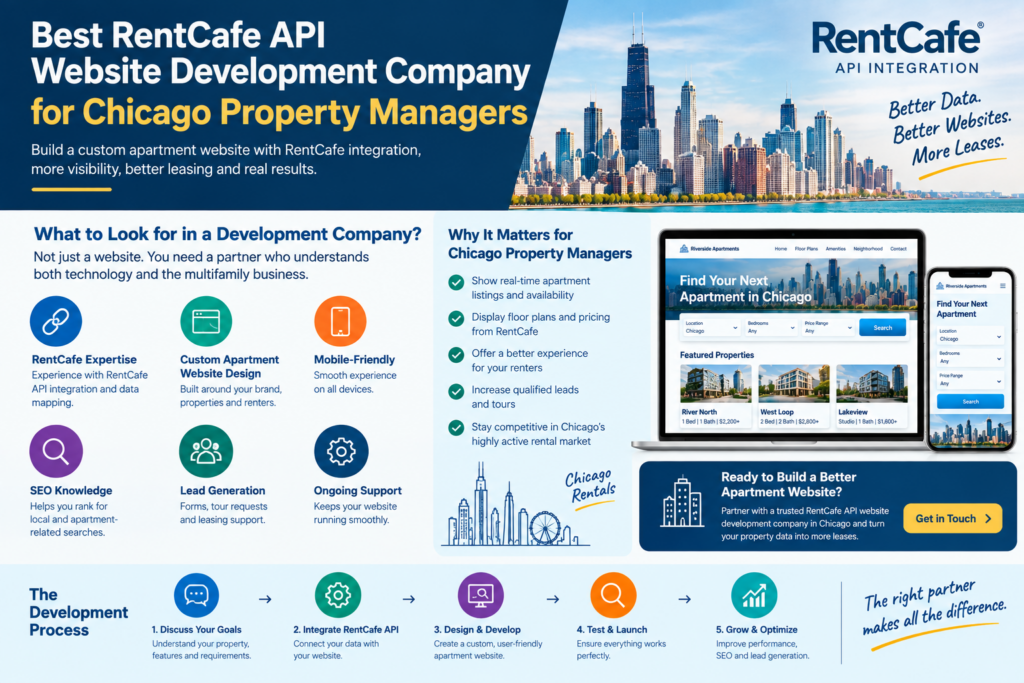
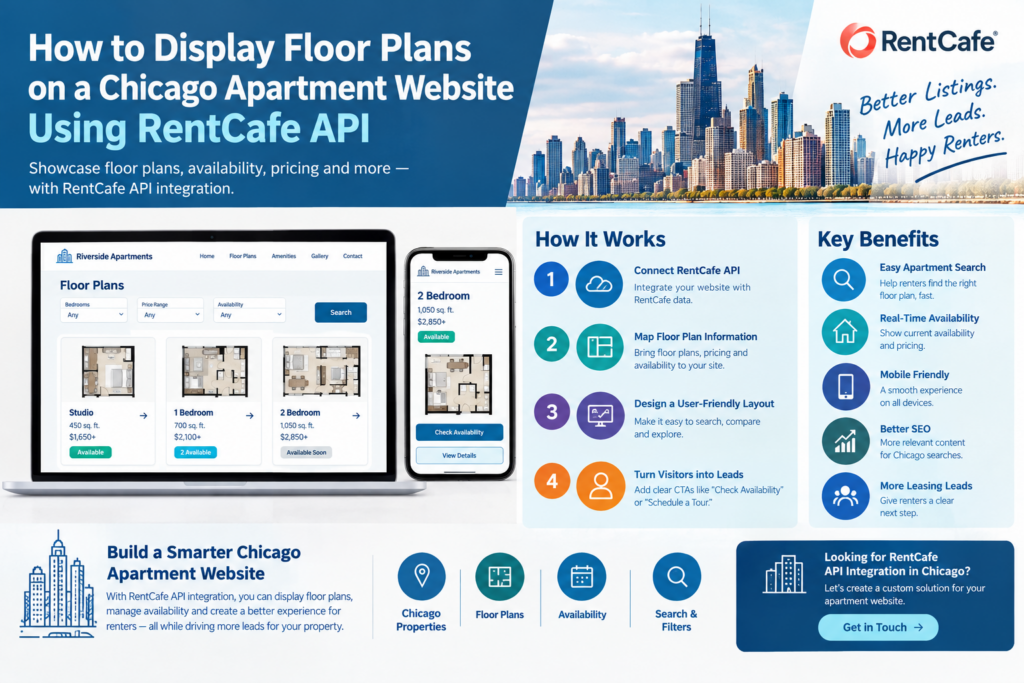
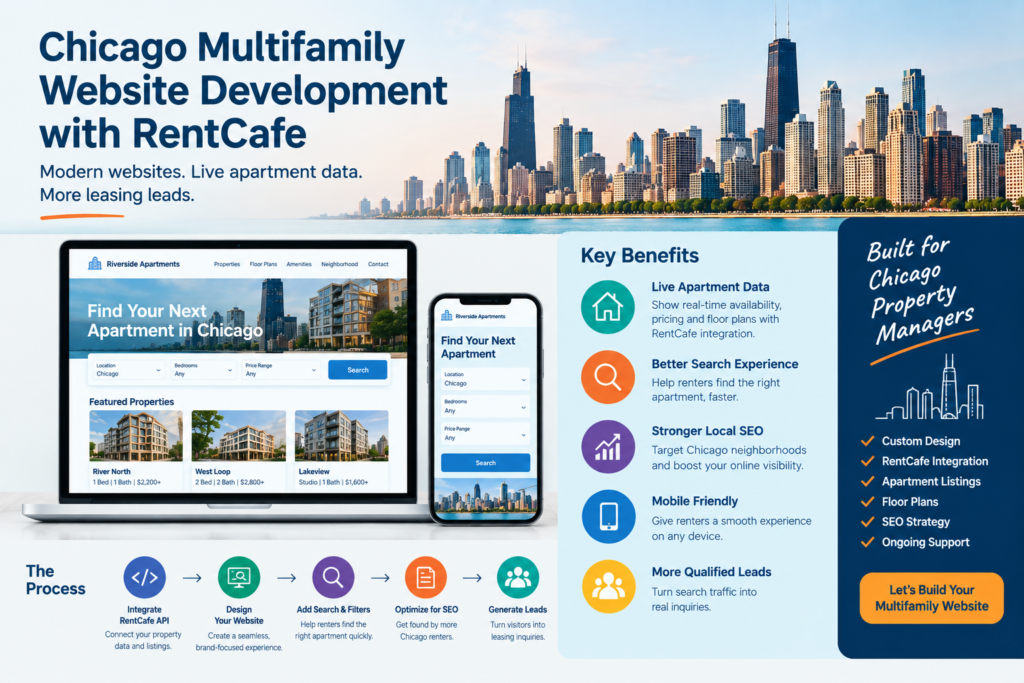
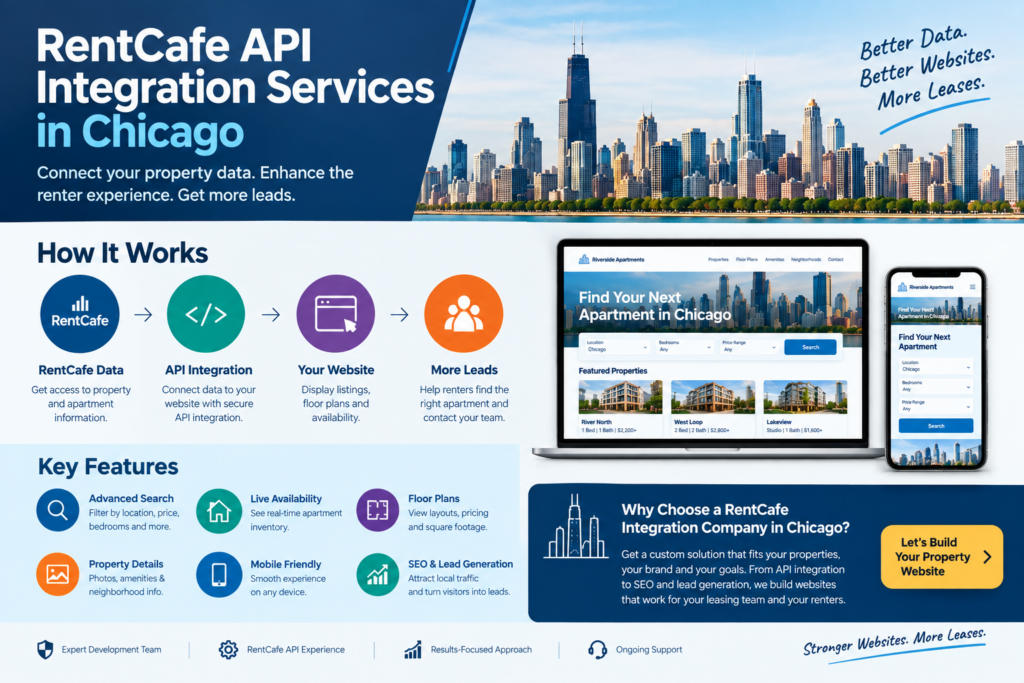
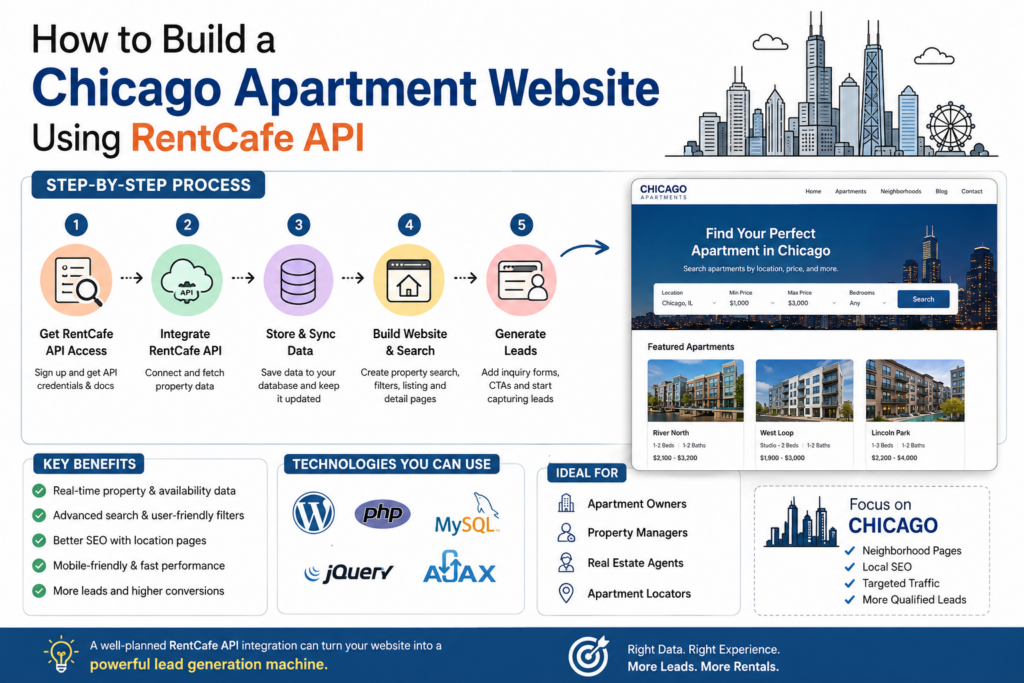
How to Build a Chicago Apartment Website Using RentCafe API

How to Build a Chicago Apartment Website Using RentCafe API

Building an apartment website for Chicago is not really about putting a few property photos on a WordPress page and adding a “Contact Us” button. If the goal is to generate rental leads, the website needs to help people find the right apartment quickly—and give them a reason to contact you.

That is where a Chicago apartment website RentCafe API integration can become useful.

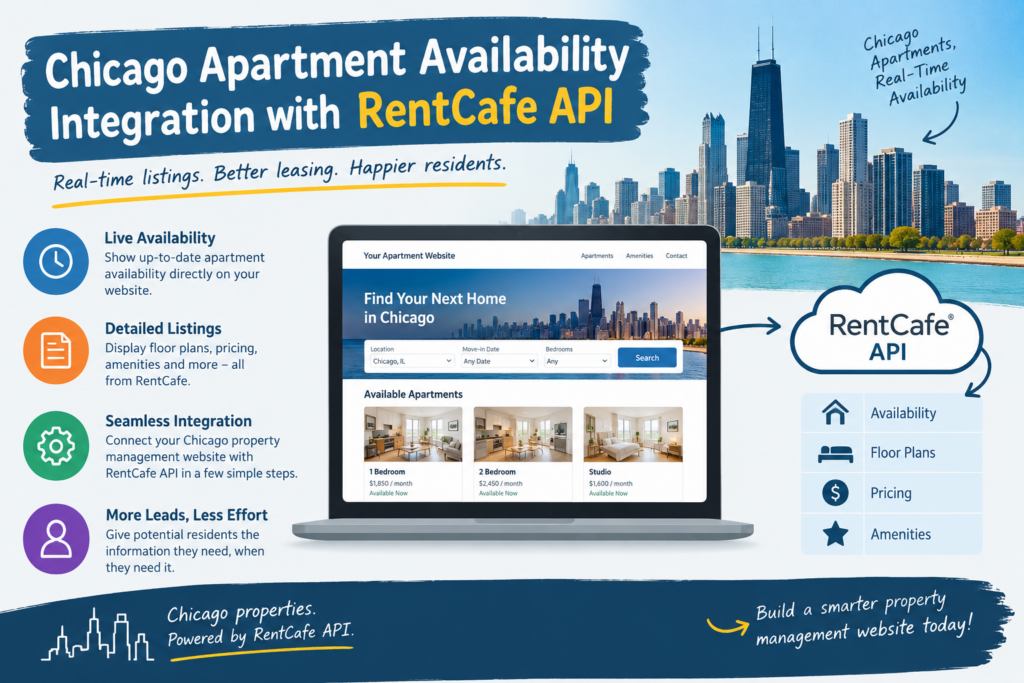
Instead of manually adding hundreds of apartments, floor plans, pricing details, amenities and availability, you can connect your website to property data through the RentCafe API and display relevant information automatically. The result can be a much more useful apartment listing website Chicago renters can actually search and use.

I’ve worked on real estate websites where the biggest problem wasn’t the design. It was keeping property information accurate while making the site easy for users and search engines to understand. API integration helps solve part of that problem, but the way you structure the website matters just as much.

Let’s look at how I would approach it.

What a Chicago Apartment Website Should Actually Do

Before touching the API, decide what the website needs to accomplish.

A good Chicago rental website should allow someone to browse properties, narrow results by location and budget, view apartment details, compare options and submit an inquiry without jumping through five different pages.

For example, a renter might be looking for:

  • Apartments in River North
  • 1-bedroom apartments in Chicago
  • Pet-friendly apartments
  • Apartments under $2,500
  • Apartments near public transportation
  • Luxury apartments in downtown Chicago
  • Apartments with parking
  • Available apartments near a specific neighborhood

The website should make those searches easy.

Your API integration then becomes the engine behind the property data while the website handles the user experience, SEO and lead generation.


Understanding the RentCafe API Integration

RentCafe provides property management and apartment marketing technology, and API access can be used to connect property information with another website or application, depending on the access and API arrangement available for the project.

This is an important point: don’t start development until you know exactly which RentCafe API endpoints and data fields you have access to.

Depending on the integration, your data may include information such as:

  • Property name
  • Property address
  • Apartment units
  • Floor plans
  • Bedroom and bathroom count
  • Rent
  • Square footage
  • Availability
  • Amenities
  • Property images
  • Community information
  • Unit details

A developer can then map this information into your website’s database.

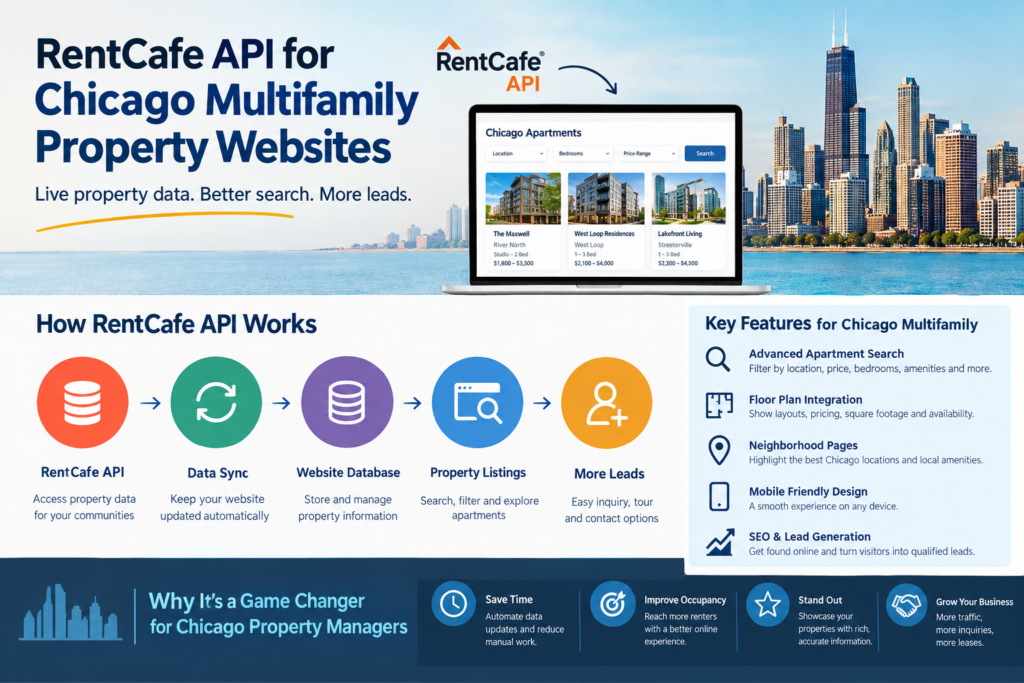
For a WordPress project, I normally wouldn’t recommend making the website request the external API every time someone opens a property page. That can make the website slower and creates unnecessary dependency on the external service.

A better approach is often:

RentCafe API → Scheduled Sync → WordPress Database → Website

The website displays locally stored information, while a scheduled process periodically checks for changes.

That architecture is much easier to manage.


Building the Website Architecture

For a Chicago apartment website, I would separate the data into logical components instead of treating every property as a normal blog post.

A simple structure could look like this:

Properties

Each property represents an apartment community.

Floor Plans

Each property can have multiple floor plans such as studio, 1-bedroom, 2-bedroom and 3-bedroom apartments.

Units

Individual available units can contain rent, availability date, square footage, floor and other information.

Amenities

Amenities can be attached to the property or individual units.

Locations

Chicago neighborhoods can be handled separately so the website can create useful location pages.

This structure becomes particularly powerful for SEO.

Instead of having only /apartments/, you could eventually have pages targeting searches such as:

/chicago-apartments/

/chicago-1-bedroom-apartments/

/apartments-river-north-chicago/

/apartments-lincoln-park-chicago/

/luxury-apartments-chicago/

Obviously, you don’t want to generate thousands of thin pages just because the API gives you thousands of possible combinations. Every indexable page should have a genuine purpose and useful content.


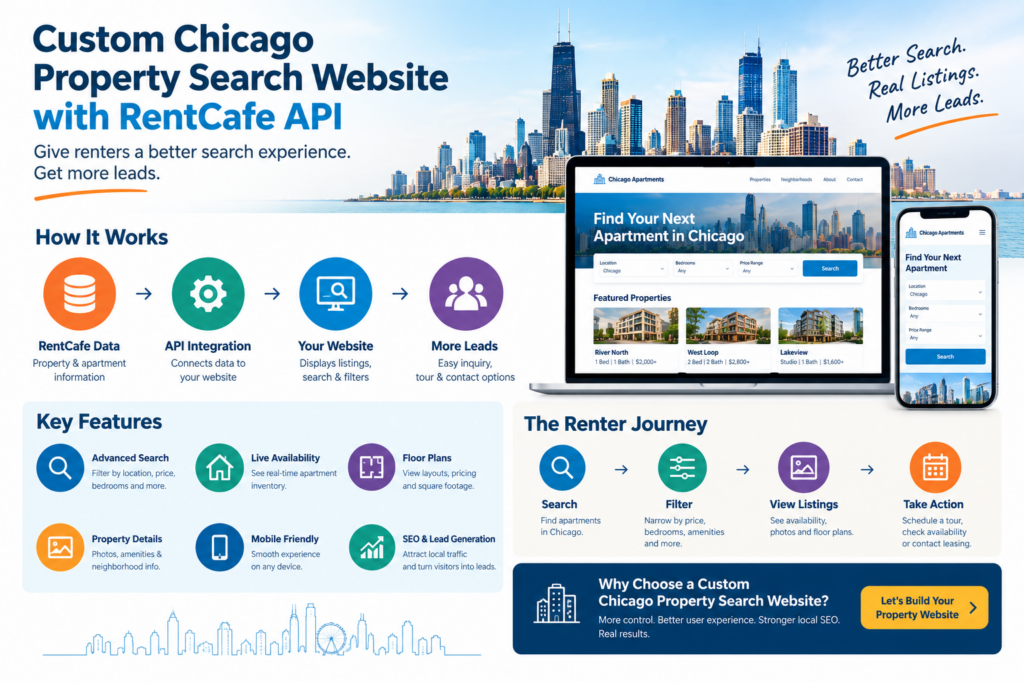
How the Chicago Apartment Search Should Work

This is where many real estate websites either become useful—or frustrating.

The search interface should be simple.

A visitor could start with:

Location → Bedrooms → Price → Amenities → Availability

Then the website returns matching properties.

For example:

Chicago → 2 Bedrooms → $2,000–$3,000 → Pet Friendly

The results page can display apartment cards containing the property image, name, neighborhood, rent range, bedrooms, bathrooms and a clear button such as View Apartments or Check Availability.

Don’t overload the first screen with 30 filters.

People generally want to narrow down their options quickly. You can put advanced filters behind an “More Filters” option.

For larger Chicago markets, map-based search can also be useful, particularly when location is an important part of the buying—or in this case renting—decision.


Creating Property Pages That Generate Leads

The property detail page is where your API integration and marketing strategy need to work together.

A basic property page shouldn’t just dump API fields onto the screen.

Instead, structure it like a real apartment marketing page.

Start with:

Property Name

Chicago neighborhood/location

Starting rent

Available floor plans

Photos

Amenities

Apartment features

Nearby attractions and transportation

Availability

Then give the visitor a clear next step.

For example:

Interested in this Chicago apartment?
Request current pricing and availability from our team.

The lead form can ask for basic information such as name, email, phone and preferred apartment type.

If you’re building the website for an apartment locator, property manager or real estate company, these leads can become much more valuable than simply sending visitors to an external listing platform.


Using RentCafe API Data Without Creating an SEO Mess

This is one of the areas I would pay close attention to.

API-driven websites can create thousands of URLs very quickly.

Imagine you have 500 properties, 20 floor plans per property and multiple availability combinations. If every variation becomes an indexable URL, you can end up with a huge collection of near-duplicate pages.

Google doesn’t need 50 pages that say essentially the same thing.

Instead, create strong landing pages around genuine search demand.

For example:

Chicago Apartment Listing Website

Your main apartment search page can target broader Chicago apartment searches.

Then create useful neighborhood pages around locations that actually matter to renters.

A neighborhood page might include:

  • Local apartment listings
  • Typical apartment types
  • Price ranges
  • Transportation information
  • Local amenities
  • Nearby neighborhoods
  • Frequently asked questions

This gives the page context beyond the API data.

If you’re also working on the broader SEO strategy, a guide such as real estate website SEO strategies can help connect informational content with your apartment listings.


Making the Website Fast

API integration doesn’t automatically mean a slow website.

The problem usually comes from poor implementation.

I would recommend storing synchronized property information locally and using scheduled updates rather than making repeated API calls for every visitor.

You can also use:

  • Image compression
  • WebP images
  • Browser caching
  • CDN delivery
  • Lazy loading
  • Database indexing
  • Lightweight search queries
  • Server-side caching

The goal is simple: the visitor shouldn’t have to wait for several external API requests before seeing apartments.

A fast website also creates a better experience on mobile, which matters enormously for rental searches.


Mobile Experience Is Not Optional

A lot of apartment searches happen while people are away from their computers.

Someone might be sitting on the train, browsing apartments on their phone, and saving a few properties to investigate later.

Your Chicago apartment website needs to work properly on a small screen.

Search filters should be easy to open.

Apartment cards should be readable.

Images shouldn’t push the important information halfway down the page.

And the inquiry button should be easy to find.

I usually recommend keeping a strong mobile CTA visible on property pages—something like Check Availability or Request Information.

Small details like that can make a surprisingly big difference in lead conversion.


Why You May Want a RentCafe Developer in Chicago

If your project depends heavily on RentCafe data, hiring a generic WordPress developer isn’t always enough.

A RentCafe developer Chicago project requires someone who understands both sides of the equation: API integration and real estate websites.

The developer needs to think about things like API authentication, data mapping, synchronization, error handling, database structure, property URLs, availability changes and website performance.

For example, what happens if an apartment that was available yesterday is rented today?

The website shouldn’t continue showing it as available indefinitely.

Your synchronization system needs to update the record, remove outdated availability or mark it appropriately.

That is the kind of practical issue that isn’t obvious when you’re simply designing the homepage.


Adding Chicago Neighborhood SEO

Chicago gives you a lot of opportunities for location-based SEO.

Depending on your actual inventory, you might build useful pages around areas such as:

  • River North
  • Lincoln Park
  • West Loop
  • South Loop
  • Lakeview
  • Streeterville
  • Gold Coast
  • Wicker Park
  • Logan Square
  • Hyde Park

Don’t create these pages just for keywords.

If you have apartments in River North, build a genuinely useful River North apartment page. Show relevant listings, explain the area, discuss transportation and link to related properties.

This creates a much stronger apartment listing website Chicago than a collection of automatically generated pages.


Internal Linking That Makes Sense

Internal links should help users move around the site, not just exist because an SEO checklist says you need them.

For example, from a Chicago apartment guide, you could naturally link to:

Chicago apartment search

Best Chicago neighborhoods for renters

Chicago real estate website development

And from a neighborhood page, link back to relevant apartment listings.

You can also create supporting content around questions renters actually ask, such as how much a 1-bedroom apartment costs in Chicago, which neighborhoods are best for commuting, or what amenities are common in luxury apartment buildings.

That combination of useful content + live listings gives the website more depth.


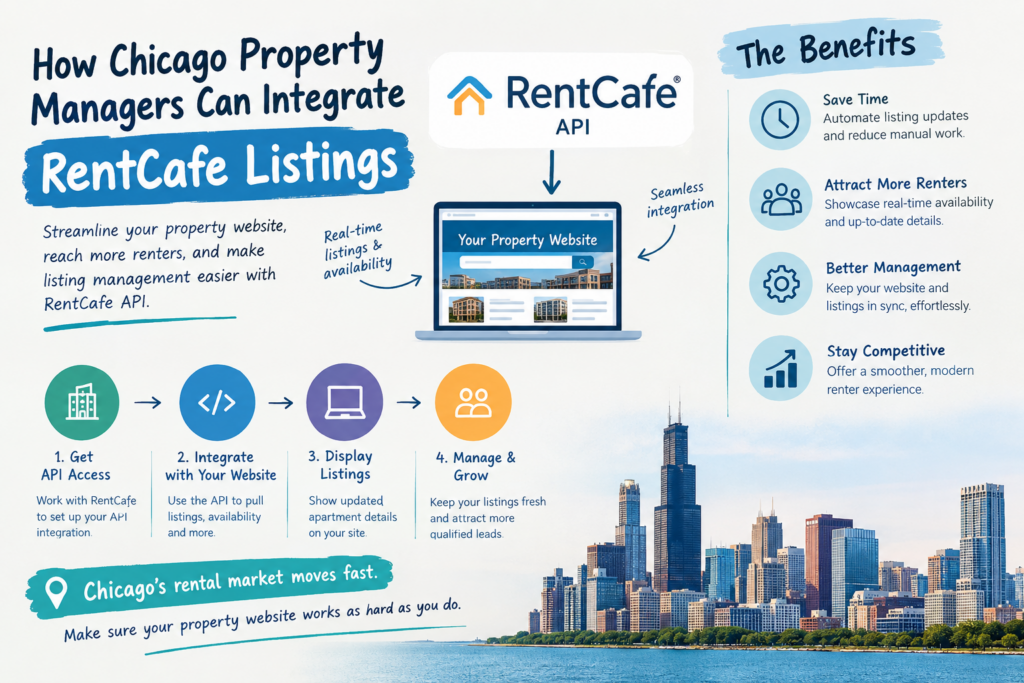
A Practical RentCafe API Development Workflow

A project like this can be broken down into a fairly straightforward process.

1. Get API documentation and credentials

Understand available endpoints, authentication and usage limits before development starts.

2. Define the website data structure

Decide how properties, units, floor plans, amenities and locations will be stored.

3. Build the API integration

Create the connection between RentCafe and your website.

4. Build the synchronization system

Set up scheduled imports and updates.

5. Create the apartment search

Add filters, sorting and pagination.

6. Build property and floor-plan pages

Make the API information useful and readable instead of displaying raw data.

7. Add SEO architecture

Create optimized category, neighborhood and property URLs.

8. Add lead generation

Use inquiry forms, calls to action and conversion tracking.

9. Test everything

Check API failures, unavailable units, duplicate records, mobile layouts, speed and forms.

10. Launch and monitor

After launch, monitor search performance, leads and data synchronization rather than considering the project “finished.”


Turning Apartment Traffic Into Real Leads

Getting visitors is only half the job.

If someone lands on a property page and can’t figure out what to do next, you’ve wasted the opportunity.

Give them several natural ways to contact you:

Check Availability

Request Pricing

Schedule a Tour

Ask a Question

Get Apartment Recommendations

You can also capture broader leads from visitors who aren’t ready to contact you about a specific property.

For example:

Not sure which Chicago neighborhood is right for you? Tell us what you’re looking for and we’ll help narrow down the options.

That’s a much softer CTA than “Contact Us Now,” and it gives the visitor a reason to submit the form.


Final Thoughts

A successful Chicago apartment website RentCafe API project isn’t simply an API integration.

The API provides the property data, but your website has to turn that data into something useful.

The strongest setup combines accurate apartment information, fast search, neighborhood-focused SEO, mobile-friendly property pages and a simple lead-generation process.

If you’re building an apartment listing website for Chicago and already have RentCafe access, the next step is to map out the API data and website architecture before starting the actual development. That can save a lot of rework later.

And if you’re planning to build a real estate website around WordPress, you may also want to explore a complete real estate WordPress website guide before choosing the final architecture.

Need a Chicago apartment website connected to RentCafe? A properly planned integration can give you a website that isn’t just displaying apartments—it can become a real lead-generation channel for your business.


FAQ: Chicago Apartment Website Using RentCafe API

1. Can I build a Chicago apartment website with RentCafe API?

Yes, provided you have the appropriate RentCafe API access and documentation. The API can be integrated with WordPress or a custom application to synchronize property and apartment information.

2. Can RentCafe API show apartment availability?

The available data depends on the specific API access and endpoints provided for your account. If availability information is exposed, it can be synchronized with your website and displayed to visitors.

3. Can I build the website with WordPress?

Yes. WordPress can work well for this type of project when the API integration is developed properly. Property data can be stored in a custom database structure or custom post type architecture, depending on the requirements.

4. How often should apartment data be synchronized?

It depends on how frequently availability and pricing change. For active rental inventories, scheduled synchronization several times per day may be more appropriate than a weekly update.

5. Can I create Chicago neighborhood pages?

Yes, and this can be particularly useful for SEO. Pages targeting neighborhoods such as River North, Lincoln Park, West Loop and South Loop can combine relevant apartment listings with genuinely useful local information.

6. Can the website include apartment search filters?

Yes. Filters can be created for factors such as location, bedrooms, bathrooms, price, square footage, amenities and availability, depending on the data available through the API.

7. Can RentCafe data be used for SEO?

API data can be displayed on SEO-friendly pages, but simply importing the same data into hundreds of pages isn’t enough. The website should add unique, useful content and avoid creating large numbers of duplicate or thin pages.

8. How much does a RentCafe apartment website cost?

The cost varies considerably depending on API requirements, number of properties, search functionality, design, CRM integration, automation and whether the project uses WordPress or a custom application.

9. Should I hire a RentCafe developer for the project?

If RentCafe integration is central to the website, working with a developer who understands API integrations and real estate websites can reduce technical problems and make the project easier to maintain.

10. Can the website generate apartment leads?

Yes. Property inquiry forms, tour requests, availability requests, phone CTAs and recommendation forms can all be integrated into the website to turn apartment search traffic into leads.


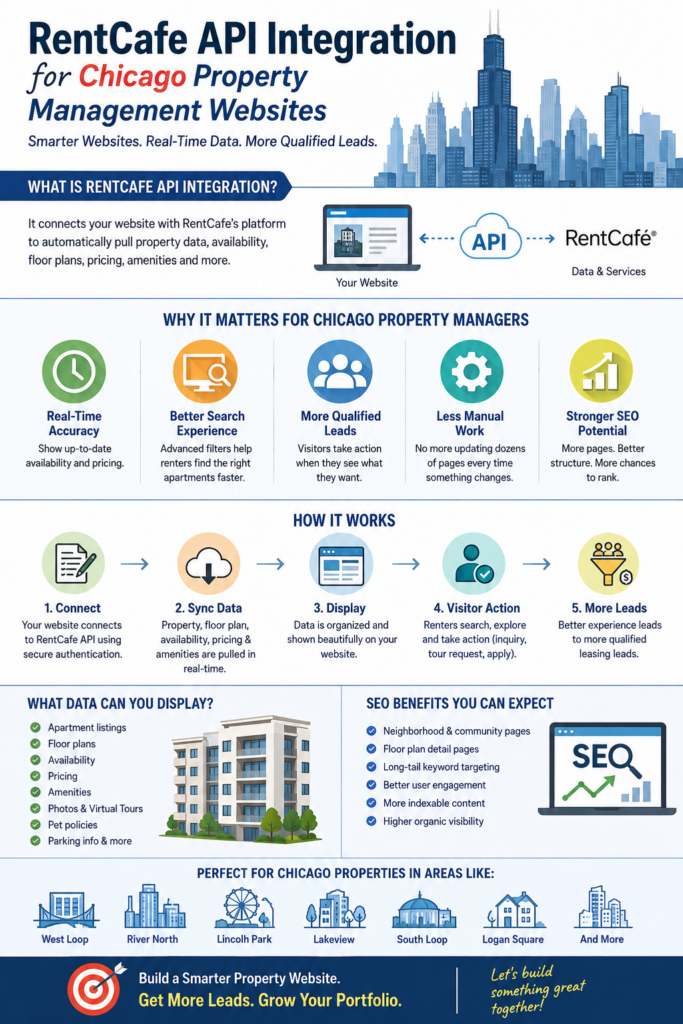
RentCafe API Integration for Chicago Property Management Website

RentCafe API Integration for Chicago Property Management Websites


If you manage apartment communities in Chicago, your website has one job that matters more than flashy design: help renters find the right property and take the next step quickly.

That sounds simple until you have dozens of apartment communities, constantly changing availability, pricing, floor plans, amenities, photos, and leasing information.

This is where RentCafe API integration Chicago can become useful.

Instead of maintaining apartment information manually across a Chicago property management website, an integration can connect your website with the data and services available through the RentCafe ecosystem, depending on the API access and capabilities provided for your account. The goal is straightforward: make property information easier to manage while giving prospective renters a smoother online experience.

For Chicago property managers, developers, and real estate companies, this can be especially valuable because renters often compare multiple communities before submitting an inquiry or scheduling a tour.

A well-built integration can help turn that comparison process into an opportunity for your business.

Why Chicago Property Management Websites Need Better Property Data

Chicago’s rental market is competitive. A prospective tenant might search for apartments in River North, West Loop, South Loop, Lincoln Park, Lakeview, Logan Square, or neighborhoods farther outside downtown.

They are not just looking for a nice-looking website.

They want answers.

What apartments are available? What’s the rent? Which floor plans are offered? Are pets allowed? What amenities are available? Is parking offered? Can they schedule a tour? Can they apply online?

When those answers are difficult to find, people leave the website.

The challenge for property management companies is keeping all of that information accurate without turning website management into a full-time administrative task.

A Chicago property management website connected to a centralized property data source can make the process considerably easier.

Rather than asking a marketing employee or developer to update every apartment page whenever something changes, the website can be designed to retrieve and display relevant property information through an appropriate integration.

What Is RentCafe API Integration?

At a practical level, RentCafe API integration means connecting a website or application with available RentCafe data or functionality through an authorized API connection.

The exact data and operations available depend on the RentCafe products, account permissions, API access, and documentation provided to the property management company.

A typical integration project may involve connecting property information with a website’s:

  • Apartment listings
  • Floor plans
  • Availability information
  • Pricing
  • Community details
  • Amenities
  • Property images or related content
  • Leasing or inquiry workflows
  • Search and filtering features

The important part isn’t simply “connecting an API.”

The real value comes from designing the website around the data.

For example, a renter searching for a two-bedroom apartment under a certain price should be able to find relevant options without clicking through ten different pages.

That is where good apartment website development Chicago services can make a difference.

How RentCafe API Integration Can Improve a Chicago Apartment Website

A property website should behave more like a useful leasing tool and less like an online brochure.

Imagine a renter lands on your website and immediately sees available apartments. They select two bedrooms, choose a price range, review floor plans, check amenities, and then request a tour.

That’s a much better journey than forcing them to call the leasing office just to find out whether a particular floor plan is currently available.

1. Reduce Manual Property Updates

Apartment availability changes constantly.

Units get leased. New units become available. Pricing changes. Move-in dates change.

If your team has to update the website manually every time something changes, information can become outdated surprisingly quickly.

An API-based approach can reduce repetitive data entry by allowing the website to retrieve relevant information from the connected system.

That means your team can spend less time copying information between platforms and more time handling actual leasing activity.

2. Create Better Apartment Search Experiences

Chicago renters have very specific requirements.

Someone working downtown might prioritize proximity to the Loop. Another renter may care more about parking or pet-friendly policies. A family may need multiple bedrooms and specific amenities.

A properly designed website can use available property data to build useful filters around factors such as:

  • Bedroom count
  • Bathroom count
  • Price range
  • Floor plan
  • Availability
  • Community
  • Amenities
  • Move-in requirements

This improves user experience while also helping visitors find relevant inventory faster.

3. Build Individual Property and Floor Plan Pages

For companies managing multiple communities, one of the biggest website challenges is creating useful pages for every property without duplicating thin content.

API-connected websites can be structured around individual communities, floor plans, and available apartments.

For example, a property page could contain a community overview followed by available floor plans. A renter could then move from the floor plan to current availability and finally to a leasing inquiry.

From an SEO perspective, this also creates opportunities to target more specific searches.

Instead of trying to rank one generic page for “Chicago apartments,” a website can potentially create useful content around specific properties, neighborhoods, floor plans, and apartment-related searches.

The pages still need unique, valuable content. Simply displaying database fields isn’t enough.

RentCafe API Integration Chicago: SEO Benefits Worth Considering

API integration itself does not automatically make a website rank higher.

That’s an important distinction.

Google doesn’t award rankings just because a website uses an API.

The SEO advantage comes from what you build with the data.

A well-planned integration can support a larger website architecture where users can discover relevant property pages, floor plans, amenities, and location-based content.

For example, a Chicago property management company could create helpful content around searches such as:

Apartments in Chicago

Luxury apartments in Chicago

Apartments near the Chicago Loop

Pet-friendly apartments in Chicago

Apartments in West Loop

Apartments in River North

Chicago apartment floor plans

These pages should provide genuine value rather than simply repeating property data.

A strong strategy combines structured property information with original content about the community, neighborhood, leasing process, amenities, transportation, and other questions renters actually have.

Long-Tail Opportunities for Chicago Property Managers

One of the biggest missed opportunities on apartment websites is ignoring long-tail search terms.

Someone searching “apartments in Chicago” is still researching.

Someone searching “two bedroom apartment with parking in West Loop Chicago” has a much clearer intent.

Your website should be able to support both.

Depending on the properties you manage, your SEO strategy could target combinations of:

  • Chicago apartment rentals
  • Chicago apartment communities
  • Luxury apartment buildings Chicago
  • Affordable apartments Chicago
  • Two-bedroom apartments Chicago
  • Pet-friendly apartments Chicago
  • Apartments with parking Chicago
  • Apartments near downtown Chicago
  • West Loop apartment rentals
  • River North apartments
  • Lincoln Park apartments
  • Lakeview apartments
  • South Loop apartments
  • Chicago apartment floor plans
  • Chicago property management companies

The trick is not creating hundreds of nearly identical pages.

Create pages when you have something genuinely useful to say.

What a Good Integration Project Should Include

A successful apartment website development Chicago project should start with the business requirements, not the API.

Before development begins, determine what information the website needs and what the leasing team actually wants visitors to do.

For example, ask:

What properties need to be displayed?

Which property fields are available?

How frequently should information be refreshed?

What happens when a property becomes unavailable?

How should floor plans be displayed?

What filters should renters have?

Where should inquiries go?

How should mobile users interact with the listings?

What happens when API data is unavailable?

That last question gets overlooked.

A good integration needs sensible error handling, caching where appropriate, performance optimization, and a fallback experience. Your website shouldn’t become unusable simply because an external service temporarily has an issue.

RentCafe API Integration and Lead Generation

The end goal isn’t just showing apartments.

It’s generating qualified leasing leads.

A visitor who finds the right apartment should have a clear next action.

That might be:

Schedule a tour

Request information

Check availability

Apply now

Contact leasing

Don’t hide these actions at the bottom of a page.

Place them naturally throughout the renter journey.

For example, after displaying a floor plan, provide an obvious way to ask about that specific apartment. If someone is viewing a community page, make it easy to schedule a tour.

Small changes like these can have a meaningful impact on conversion rates.

And because the website is handling more of the initial research process, leasing staff can spend more time with prospects who are already interested.

Choosing the Right Chicago Web Development Partner

RentCafe API integration isn’t just a web design project.

It combines website development, API integration, database or data-handling logic, user experience, SEO, and lead-generation considerations.

That’s why it’s worth choosing a developer who understands both sides of the project.

A beautiful apartment website that displays outdated availability isn’t very useful.

Likewise, a technically impressive API integration with a confusing user interface won’t generate many leads.

The strongest projects connect the technical work with the actual leasing workflow.

If you’re already planning a new site, you may also want to review your broader Chicago real estate website development strategy before development begins. This can help you decide which pages, search features, and conversion paths should be included from the start.

Similarly, if your current website receives traffic but produces few inquiries, consider reviewing your apartment website conversion optimization strategy rather than assuming a complete redesign is the answer.

Is RentCafe API Integration Worth It for a Chicago Property Management Company?

For companies managing a substantial number of apartments or multiple communities, it can be worth considering.

The biggest benefit isn’t the API itself.

It’s the ability to create a website that connects property information with a better renter experience.

Instead of treating the website as a static marketing asset, you can build it as part of the leasing process.

That can mean easier inventory management, better apartment discovery, more useful property pages, stronger long-tail SEO opportunities, and a clearer path from Google search to leasing inquiry.

Of course, the right approach depends on your RentCafe setup, available API access, website platform, property portfolio, and business requirements.

Before development, confirm the available API capabilities and data permissions rather than assuming every RentCafe feature is accessible through an API.

Ready to Improve Your Chicago Property Management Website?

If your Chicago property management website is still relying heavily on manual apartment updates, disconnected listing systems, or a poor search experience, it may be time to rethink the setup.

A properly planned RentCafe API integration Chicago project can bring property data, website functionality, SEO, and lead generation together in one smoother experience.

The best place to start is usually a technical and business review: what data you have, what your website needs, what renters are searching for, and where your current leasing funnel is losing prospects.

If you’re considering a RentCafe-connected website for Chicago properties, a developer can review your requirements and map out the integration before any major development work begins.


Frequently Asked Questions

What is RentCafe API integration for a Chicago property management website?

RentCafe API integration connects an authorized website or application with available RentCafe data or functionality so relevant property information can be displayed or used within the website. Available capabilities depend on the account, permissions, products, and API access provided.

Can RentCafe API integration display apartment availability?

It can, where the relevant availability data and API access are provided for the specific RentCafe setup. The website can then be designed to present available inventory in a renter-friendly format.

Can a Chicago apartment website show floor plans through an API?

Potentially, yes. If the required floor-plan information is available through the authorized integration, developers can design pages that organize floor plans and related apartment information for visitors.

Does RentCafe API integration improve SEO?

The integration itself is not an SEO ranking factor. However, property and availability data can support a stronger website structure, useful apartment pages, better search experiences, and more relevant long-tail content when implemented correctly.

How can API integration help Chicago property managers generate leads?

It can make it easier for renters to find relevant apartments and move toward actions such as requesting information, checking availability, scheduling a tour, or applying. A good conversion-focused design is still essential.

Is API integration useful for companies managing multiple Chicago properties?

Yes, it can be particularly useful when a company has multiple communities or a large amount of changing apartment information. Centralizing or automating appropriate data flows can reduce repetitive website maintenance.

How much does RentCafe API integration cost?

There isn’t one standard price. Cost depends on the website platform, API requirements, available data, number of properties, custom search functionality, design, testing, and other development requirements. A technical review is the best way to estimate the project accurately.

Can RentCafe API integration work with an existing WordPress website?

It may be possible, depending on the available API access and the existing WordPress setup. A developer would need to review the API documentation, authentication requirements, website architecture, and desired functionality before recommending an implementation.

Can this strategy target neighborhoods such as River North or West Loop?

Yes. A Chicago property website can create useful neighborhood-focused pages when the company has relevant properties and genuinely useful information for renters. Pages should offer more than simply changing the neighborhood name on duplicate content.

Should I build a custom apartment website around RentCafe data?

For companies with complex property portfolios, custom search requirements, multiple communities, or specific lead-generation goals, a custom solution may make sense. The right choice depends on your business and technical requirements.

Real Estate Website Design Tips for More Leads (2026 Guide That Actually Works)

Real Estate Website Design Tips for More Leads (2026 Guide That Actually Works)


Introduction

Let’s not sugarcoat this—most real estate websites don’t fail because of traffic.

They fail because they don’t convert visitors into leads.

You can spend money on ads, SEO, social media… but if your website isn’t designed the right way, people will visit and leave without doing anything.

No inquiry. No call. No deal.

And this is exactly why many agents in the USA are now looking for a real estate website developer USA who understands not just design—but conversions.

Because today, your website isn’t just a portfolio.
It’s your lead generation system.


What makes a real estate website actually generate leads?

Before jumping into tips, let’s clear one thing.

A high-converting website is not about:

  • fancy animations
  • heavy design
  • too many features

It’s about clarity + speed + direction.

A good real estate website:

  • tells users what to do
  • makes it easy to take action
  • builds trust quickly

That’s it.


Why your real estate website is not converting visitors

This is something I see all the time.

People say:
👉 “My website looks good, but I’m not getting leads.”

Here’s what’s usually going wrong:

1. No clear call-to-action

Users don’t know what to do next.


2. Too much distraction

Sliders, animations, popups—everything at once.

Instead of helping, it confuses users.


3. Poor mobile experience

More than 70% of users are on mobile.
If your site isn’t smooth there—you’re losing leads.


4. No trust elements

No reviews, no testimonials, no proof.

Why would someone contact you?


5. Weak structure

The website looks fine—but it doesn’t guide users.


How to improve real estate website conversion rate

Now let’s get practical—these are the things that actually work.


1. Keep your homepage simple (seriously)

Your homepage should answer 3 things immediately:

  • What do you offer?
  • Where do you operate?
  • What should the user do next?

If this is not clear in 5 seconds, users leave.


2. Use strong and clear CTAs

Buttons like:

  • Get Property Details
  • Book a Visit
  • Schedule a Call

should be visible without scrolling.

Not once—multiple times.


🔥 CTA SECTION (High Conversion)

If your website is not generating leads right now, you are losing potential clients every day.

👉 Hire a professional real estate website developer in the USA and turn your website into a lead machine.


3. Focus on mobile-first design

Don’t design for desktop first.

Start with mobile:

  • faster loading
  • simple layout
  • easy navigation

Because that’s where most of your users are.


4. Speed matters more than design

A slow website kills everything:

  • SEO
  • user experience
  • conversions

If your site takes more than 3 seconds to load, users leave.


5. Use landing pages instead of sending traffic to homepage

This is one of the biggest mistakes.

If you’re running ads or targeting keywords like:

  • homes in New York
  • flats in California

Send users to a dedicated page, not your homepage.


6. Work with the right developer (this matters a lot)

Not all developers understand real estate.

You need someone who knows:

  • lead generation
  • IDX integration
  • MLS data
  • SEO structure

That’s why many businesses now prefer:

  • hire real estate website developer USA
  • wordpress real estate website developer USA

Because they understand both tech + marketing.


7. Use IDX and MLS integration properly

If you are in the USA, IDX and MLS are critical.

An IDX real estate website developer helps you:

  • show live property listings
  • improve user experience
  • keep content updated automatically

This also improves SEO.


8. Build trust immediately

Add:

  • client testimonials
  • reviews
  • project success stories

Even small trust signals increase conversions.


9. Optimize your property listings

Your listings should not just display—they should sell.

Include:

  • high-quality images
  • clear pricing
  • features
  • location benefits

10. Add multiple contact options

Don’t rely on one method.

Use:

  • forms
  • call buttons
  • WhatsApp (if applicable)

Make it easy for users to reach you instantly.


Real estate website design for realtors (what actually works in USA)

If you’re targeting the US market, expectations are higher.

Users expect:

  • fast websites
  • clean design
  • accurate data
  • easy navigation

That’s why many agents invest in:

  • custom real estate website development USA
  • real estate web design company USA

Because template-based sites often fail to convert.


Choosing the best real estate website developer for agents USA

This decision can make or break your results.

Look for:

  • experience in real estate
  • knowledge of IDX/MLS
  • SEO understanding
  • conversion-focused design

Avoid developers who only focus on design.


Affordable real estate website design USA (what to expect)

Many people think:
👉 “Affordable = low quality”

That’s not always true.

A good developer can create:

  • fast
  • optimized
  • lead-focused website

without overcharging.

The key is choosing the right person or agency.


Real estate lead generation website services (what you actually need)

A complete solution includes:

  • website design
  • SEO
  • landing pages
  • lead capture system
  • CRM integration

Not just design.

Because design alone doesn’t generate leads.


How to generate leads from real estate website USA

Let’s simplify it:

To generate leads, your website needs:

  • traffic (SEO or ads)
  • conversion (design + CTA)
  • trust (reviews + content)

If even one of these is missing, results drop.


Quick reality check

Most websites fail because:

  • they look good but don’t convert
  • they have traffic but no strategy
  • they are built without understanding users

Fix these—and results change fast.


FAQ

Why is my real estate website not generating leads in the USA?

It usually happens due to poor design, lack of SEO, slow speed, and weak conversion strategy.


Should I hire a real estate website developer in the USA?

Yes, especially if they understand IDX, MLS, SEO, and lead generation strategies.


What is the best way to improve website conversion rate?

Focus on clear CTAs, fast loading speed, mobile optimization, and better user experience.


Do I need IDX integration for my website?

Yes, if you operate in the USA, IDX helps display updated property listings and improves user experience.


Final thoughts

At the end of the day, your website should do one thing—generate leads consistently.

Not just exist.

If your website is not converting right now, it’s not a traffic problem… it’s a strategy problem.

Fix the structure, improve the experience, and guide users properly—and you’ll start seeing results.


Final CTA

If you’re serious about growing your real estate business, don’t settle for a basic website.

👉 Work with a real estate website developer in the USA who understands lead generation, SEO, and conversion—and turn your website into a powerful business asset.


How to Generate Leads from Property Website (2026 Guide)

How to Generate Leads from Property Website (2026 Guide)

Introduction

Let’s be honest—just having a property website today is not enough.

A lot of real estate businesses build a website expecting leads to come automatically. But in reality… nothing happens.

No calls. No inquiries. No site visits.

If that sounds familiar, the problem is not your website—it’s how it’s structured, optimized, and used.

In this guide, I’ll show you what actually works in 2026 to turn your property website into a consistent lead generation system.


How to generate leads from a property website?

A property website generates leads by combining SEO, landing pages, fast user experience, and strong call-to-action elements. The goal is simple: convert visitors into inquiries through forms, calls, or WhatsApp.


Why your property website is not generating leads

Before fixing the problem, you need to understand what’s going wrong.

1. No clear action for users

If visitors don’t know what to do next, they won’t take action.


2. Poor mobile experience

Most users are on mobile. If your site is slow or confusing, they leave immediately.


3. No SEO = no traffic

Without visibility on Google, your website won’t get visitors—so no leads.

👉 If you haven’t worked on this yet, you should improve your real estate SEO strategy (internal link)


4. Weak property presentation

Low-quality images or incomplete details reduce trust instantly.


5. No proper lead capture system

No forms, no WhatsApp, no call buttons = missed opportunities.


10 proven ways to generate leads from your property website

Let’s get practical.


1. Design your website for conversion (not just looks)

A clean, simple layout works better than a fancy design.

Focus on:

  • clear messaging
  • easy navigation
  • visible contact options

2. Add strong call-to-action (CTA) everywhere

Don’t assume users will figure things out.

Use buttons like:

  • Get Price Details
  • Book Site Visit
  • Request Callback

Place them:

  • on homepage
  • property pages
  • sticky header

🔥 CTA (Add This Section in Your Page)

If your website is not generating leads right now, you’re losing potential clients every day.

👉 Get a free audit of your property website and find out exactly what’s stopping your conversions.


3. Use dedicated landing pages

Sending traffic to your homepage is a mistake.

Instead, create focused pages for:

  • specific projects
  • locations (Noida, Gurgaon, Greater Noida)

A good landing page converts much better.


4. Use SEO to get consistent traffic

SEO brings free, high-intent visitors.

Target keywords like:

  • property website leads
  • real estate lead generation
  • flats in Noida / Gurgaon

👉 You can also improve this with proper real estate website development (internal link)


5. Improve your property listings

Think like a buyer.

Your listing should answer:

  • What is the price?
  • What are the features?
  • Why this location?

Use:

  • high-quality images
  • clear descriptions
  • amenities
  • location advantages

6. Add simple lead capture forms

Don’t overcomplicate forms.

Just ask:

  • Name
  • Phone
  • Email

Short forms = higher conversion.


7. Add WhatsApp and call buttons

Many users prefer instant communication.

Adding WhatsApp can significantly increase inquiries.


8. Improve website speed

A slow website kills both SEO and conversions.

Fix:

  • image size
  • hosting quality
  • unnecessary plugins

9. Run ads for faster results

If you want quick leads:

  • Google Ads
  • Facebook Ads
  • Instagram Ads

👉 Always send traffic to landing pages (not homepage)


10. Build trust with proof

Real estate is trust-based.

Add:

  • testimonials
  • reviews
  • past project success

How to generate real estate leads in Noida, Gurgaon & Greater Noida

If you are targeting local markets, this is important.

Use:

  • location-based pages
  • local keywords
  • area-specific content

Examples:

  • flats in Noida
  • property dealers Gurgaon
  • real estate projects Greater Noida

👉 Local SEO brings high-conversion traffic


What actually works in 2026 (quick summary)

Most websites fail because they focus only on design.

What works is:

  • SEO + traffic
  • landing pages
  • fast experience
  • strong CTA

Simple—but powerful.


FAQ

How can I generate leads from my property website?

By combining SEO, landing pages, fast loading speed, and strong call-to-action buttons.


Why is my real estate website not getting leads?

Common reasons include poor SEO, slow speed, weak design, and no clear conversion strategy.


Is SEO important for property websites?

Yes, SEO brings organic traffic from Google, which increases lead opportunities.


Final CTA (Very Important)

Your website should not just exist—it should generate business.

If it’s not bringing leads right now, something is missing.

👉 Get a professional review of your website and start turning visitors into real inquiries.

Real Estate WordPress: Complete Guide to Build a High-Converting Property Website (2026)

Real Estate WordPress: Complete Guide to Build a High-Converting Property Website (2026)


Introduction

Let’s be real for a second—most real estate websites don’t fail because of design. They fail because they don’t generate leads.

And in 2026, that’s a serious problem.

People are no longer calling brokers randomly or walking into offices. They search, compare, scroll, and decide—all online. If your website doesn’t convince them in those few minutes, they’re gone… probably to your competitor.

That’s exactly where a properly built WordPress real estate website makes a difference.

Not just a “nice-looking site”… but something that actually works like a lead machine.


So what exactly is a real estate WordPress website?

In simple language, it’s your online property showroom—but smarter.

Instead of just listing properties, it helps people:

  • find what they want faster
  • trust you quicker
  • and most importantly… contact you

A good one doesn’t just show properties. It quietly pushes visitors toward taking action.


Why almost everyone is choosing WordPress now

I’ve seen agencies spend lakhs on custom websites… and still struggle.

At the same time, some agents using WordPress are generating consistent leads.

Why?

Because WordPress keeps things practical.

You don’t need to depend on a developer every time you want to:

  • add a new property
  • update pricing
  • create a new landing page

You can literally handle most of it yourself.

And from an SEO point of view, it already gives you a solid base. Google understands WordPress sites well—which helps when you’re trying to rank for terms related to real estate.


The part most people get wrong (features that actually matter)

Here’s where most websites mess up—they focus on design, not usability.

Let me simplify what actually matters:

1. Property search should feel effortless

If a user has to struggle to find a property, they won’t try harder… they’ll just leave.

Filters like location, price, and property type should be smooth and fast. No confusion.


2. If you don’t capture leads, nothing else matters

This is the biggest mistake I see again and again.

People spend money on design… but forget forms.

Every property page should give users an easy way to:

  • ask questions
  • schedule a visit
  • request details

If you make them “look” for contact options, you’ve already lost them.


3. Mobile experience is not optional anymore

Most of your traffic is coming from mobile. Not desktop.

If your site:

  • loads slowly
  • looks messy
  • or is hard to navigate

people won’t stay.

Simple as that.


4. SEO is what brings people in the first place

Without SEO, your website is like a shop in the middle of nowhere.

You need visibility.

That means:

  • using the right keywords naturally
  • writing useful content
  • and targeting specific locations

If you skip this, even the best website won’t get traffic.


Tools that actually make your life easier

You don’t need 50 plugins. Just the right ones.

For design, Elementor works well if you want flexibility.

For SEO, tools like Rank Math or Yoast help—but only if you use them properly.

And for listings, a good property plugin can save hours of manual work.

That’s it. Keep it simple.


Let’s talk about leads (because that’s the real goal)

Traffic is nice. Leads are better.

Here are a few things that actually work (not theory):

  • Add a simple form on every property page
  • Use WhatsApp—people respond faster there
  • Create pages for specific locations (this works really well for SEO)
  • Offer something useful like a brochure or price list

Also, one small trick—exit popups.

They feel annoying, but they work.


SEO in 2026 (what’s actually working)

Google has changed a lot, but one thing is still the same:

It rewards useful content.

Not keyword stuffing. Not tricks.

Just content that actually helps.

If you:

  • answer real questions
  • focus on specific locations
  • and keep updating your site

you’ll start seeing results.


Mistakes that silently kill your website

Most people don’t even realize they’re doing this:

  • No proper call-to-action
  • Slow website speed
  • Ignoring mobile users
  • No clear SEO strategy

Fix just these, and you’ll already be ahead of most competitors.


Final thought

A real estate website is not just about being online anymore.

It’s about building something that:

  • brings traffic
  • builds trust
  • and converts visitors into actual clients

WordPress just happens to be the easiest and most practical way to do that right now.