
Chicago Apartment Availability Integration with RentCafe API
A renter visits your Chicago property website looking for a one-bedroom apartment. They find a property they like, but the website says “Contact us for availability.”
That is frustrating.
The renter wants to know what is available now, what it costs, what the floor plan looks like and whether they can schedule a tour. If your website can’t answer those questions quickly, there is a good chance they will move on to another property website or apartment portal.
This is where a Chicago apartment availability API integration can make a real difference.
For property managers and multifamily companies, connecting RentCafe data with a website can make apartment inventory easier to search, easier to manage and much more useful for potential renters.
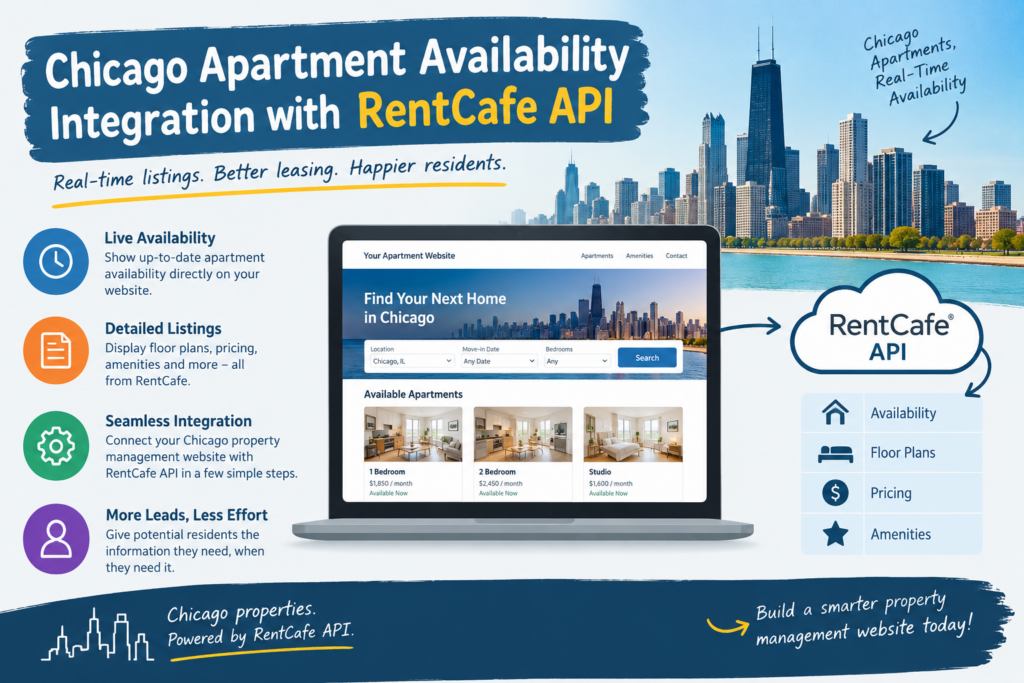
A well-planned RentCafe availability integration can bring apartment availability, floor plans, pricing and unit information into a website while reducing the need for manual updates.
But the real value isn’t the API itself.
The real value is giving renters a faster path from “I’m looking for an apartment” to “I’d like to schedule a tour.”
Why Apartment Availability Matters So Much in Chicago
Chicago’s rental market is highly competitive.
Renters have plenty of choices, and they can compare properties within minutes from their phones. If one property website provides detailed apartment information while another only shows a few photos and a contact form, the first website is likely to get more attention.
This is especially important for properties in areas such as River North, West Loop, Lincoln Park, Lakeview, South Loop, Streeterville and the surrounding Chicago neighborhoods.
Availability changes constantly.
A unit that was available yesterday might be leased today. A new unit may become available tomorrow.
For a property manager with dozens or hundreds of units, manually changing this information on the website can quickly become a headache.
That’s one of the practical reasons to consider a Chicago apartment availability API.
What Is a Chicago Apartment Availability API?
In simple terms, an apartment availability API allows a website to communicate with a property management or listing system and retrieve relevant apartment information.
When RentCafe API access is available for the specific account and project, a developer can use the available data to create a customized apartment search and availability experience.
A typical setup may look like:
RentCafe → API → Website Integration → Apartment Inventory → Search Results → Lead
Instead of manually entering every available unit into WordPress, the website can work with the connected data.
The exact information available depends on the RentCafe setup and API access, so the first step in any project should be checking what data can actually be retrieved.
That part is important. You don’t want to design a beautiful interface around information that isn’t available through your integration.
How RentCafe Availability Integration Can Help Property Managers
The biggest benefit is simple: less manual work and a better renter experience.
Imagine managing several Chicago apartment communities.
Every week, your team may need to update available units, floor plans, pricing and other information.
With an appropriate RentCafe availability integration, much of that repetitive work can be reduced through automated or synchronized data.
The website can then present the information in a way that makes sense to renters.
Instead of your marketing team constantly asking, “Is this apartment still available?” the website can become a more reliable source of current listing information.
Of course, the exact update frequency depends on the integration architecture and available data.
But even reducing manual updates can save a property management team a considerable amount of time.
Build an Apartment Inventory Website That People Actually Want to Use
An apartment inventory website shouldn’t look like an internal database.
This is a common mistake.
Property managers naturally think about inventory in terms of unit numbers, availability and pricing. Renters think differently.
They want to know:
“Can I afford this?”
“Does it have the space I need?”
“What does the apartment look like?”
“Where is it located?”
“Can I see the floor plan?”
“Can I tour it?”
Your website should translate inventory data into an easy renter experience.
For example, apartment cards could display:
1 Bedroom | 1 Bath | 750 Sq. Ft. | Available Soon
Then the visitor can click into the apartment and see more information.
That’s much more useful than simply showing a property name and a generic contact button.
Search and Filtering Make a Big Difference
If a website has a large number of available apartments, search and filters become very important.
A renter might be looking for a two-bedroom apartment under a specific price range.
Another person may only want a studio.
Someone else may need a pet-friendly apartment near their workplace.
A custom search experience can allow visitors to narrow the inventory based on relevant information.
Possible filters may include:
- Property
- Neighborhood
- Apartment type
- Bedrooms
- Bathrooms
- Price
- Square footage
- Availability
- Amenities
The filters should match the data available from the integration.
Don’t overload the user with 25 filters just because the system can technically support them.
Keep the experience simple.
The renter should be able to find suitable apartments in a few clicks.
Floor Plans Should Be Part of the Experience
Apartment availability is much more useful when the renter can understand the unit.
That’s where floor plans come in.
A good apartment page can show the floor plan together with available units, square footage, bedroom configuration and pricing information.
For example:
The Madison — 2 Bedroom
1,050 Sq. Ft.
Starting at $2,850/month
Available Units: 3
Then provide a clear floor plan and an action such as:
View Details
Check Availability
or
Schedule a Tour
The exact information depends on the available RentCafe data, but the principle remains the same.
Don’t make renters hunt for important information.
Chicago Neighborhood Search Can Support SEO
A custom apartment availability website can also support a broader local SEO strategy.
People don’t always search for a specific apartment community.
They often start with a neighborhood.
For example:
apartments in River North Chicago
1 bedroom apartments in West Loop
luxury apartments in Lincoln Park
apartments for rent in Lakeview Chicago
South Loop apartments
Chicago apartments near public transportation
These searches represent different types of renter intent.
Your website can create useful neighborhood pages and connect those pages to relevant properties and apartment inventory.
For example, a West Loop neighborhood page could explain the area’s lifestyle, transportation, restaurants, attractions and apartment options, then direct visitors to available properties.
This gives Google more context about your website and gives renters a better starting point.
If you’re also working on the broader structure of your real estate website, check our guide on building a high-converting real estate WordPress website for ideas around SEO, property pages and lead generation.
Don’t Create Thin Pages Just for Keywords
There is an SEO trap here.
Once property managers realize that Chicago neighborhoods can bring search traffic, they sometimes create dozens of pages that are almost identical.
That’s not a good strategy.
A page called “Apartments in River North” should actually tell people something useful about River North.
The same applies to West Loop, Lakeview, Lincoln Park and other neighborhoods.
Add useful local information. Explain transportation, nearby attractions, lifestyle, apartment types and relevant property options.
Then link naturally to the available apartments.
Good local SEO should help the renter first.
The search engine benefit follows from that.
How Availability Data Can Improve Lead Generation
This is where the integration becomes more than a technical project.
The goal isn’t just to show available apartments.
The goal is to generate qualified inquiries.
Let’s say someone finds a two-bedroom apartment through Google.
They see the price, floor plan, photos and availability.
Now what?
The next action should be obvious.
Schedule a Tour
Ask About This Apartment
Check Availability
Contact Leasing
The inquiry form can also capture the property and apartment the visitor was viewing.
That gives your leasing team better context.
Compare that with receiving an email that simply says:
“Interested in an apartment. Please contact me.”
The second lead requires more back-and-forth.
A properly designed website can make the inquiry much more specific.
Mobile Matters More Than You Think
Apartment searching is not limited to desktop computers.
People search for apartments on their phones while commuting, during lunch breaks, after work and sometimes while they’re physically visiting the neighborhood.
Your availability system needs to work well on mobile.
Search filters should be easy to use.
Apartment cards should be readable.
Floor plans should be accessible.
Images should load quickly.
And the contact button shouldn’t disappear somewhere at the bottom of a long page.
If a renter finds an available apartment but can’t easily contact the leasing team from their phone, you’re losing a potential lead at exactly the wrong moment.
WordPress + RentCafe API for Apartment Websites
WordPress can be a good foundation for a custom apartment website because it allows property managers and marketing teams to manage normal website content while custom development handles the more specialized functionality.
A WordPress-based project might combine:
WordPress + RentCafe API + Custom Apartment Search + Property Pages + Lead Forms + SEO
The API integration can handle the available listing information, while WordPress can manage neighborhood guides, blog content, property descriptions, FAQs and other marketing pages.
This separation can work well.
Your marketing team shouldn’t need a developer every time they want to publish a Chicago neighborhood article.
At the same time, the apartment inventory system can continue working independently in the background.
What About Website Speed?
This deserves attention before development starts.
If your website has hundreds of units and every visitor triggers multiple API requests, the website could become unnecessarily slow.
A developer should consider how listing information will be retrieved, stored, synchronized or cached.
Depending on the project, cached data may help reduce repeated requests and improve page performance.
This is especially important on mobile devices.
A renter isn’t going to wait around for a slow apartment search page to load.
They have plenty of other options.
Can Apartment Availability Data Improve Google Rankings?
It can contribute to a stronger website, but it doesn’t guarantee rankings.
This distinction is important.
A Chicago apartment availability API gives your website useful property data. But Google rankings depend on many other factors.
Your website should also have:
- Useful property content
- Chicago location pages
- Neighborhood guides
- Strong internal linking
- Optimized page titles and headings
- Fast loading pages
- Mobile-friendly design
- Good user experience
- Proper technical SEO
- Relevant structured data where appropriate
You can also target long-tail searches around specific apartment types and neighborhoods.
For example:
studio apartments in River North Chicago
2 bedroom apartments in West Loop Chicago
pet-friendly apartments in Chicago
luxury apartments near downtown Chicago
These searches can bring highly relevant visitors when the content genuinely matches the search.
Managing Multiple Apartment Communities
A custom system becomes even more useful when a company manages several properties.
Instead of creating a separate search experience for every building, you can potentially provide a central apartment finder where visitors search across the portfolio.
A renter could select:
Chicago → West Loop → 1 Bedroom
and see matching apartments.
Another renter might search:
Chicago → Pet Friendly → 2 Bedroom
and receive a different set of results.
The exact functionality depends on the available listing data and how the system is designed.
But the overall idea is powerful: one website, one search experience and multiple properties.
What Should You Ask Before Starting RentCafe Integration?
If you’re considering a RentCafe integration, don’t start development without first understanding the available data.
Ask these questions:
What RentCafe API or integration access is available?
Which apartment fields can be retrieved?
Can floor plans be displayed?
Can availability and pricing be synchronized?
Can multiple properties be supported?
How frequently can the data be updated?
How will API errors be handled?
Will the website use caching?
Can the search pages be optimized for SEO?
Can inquiries be connected to the correct property and unit?
These questions can prevent expensive changes later.
A developer who understands both RentCafe integration and apartment website development should be able to explain the approach before writing the code.
Build for the Renter, Then Build Around the Data
This is the approach I recommend.
Don’t begin with the API.
Begin with the renter.
What does someone need to know before they decide to contact a property manager?
Usually, they want to know the location, price, apartment type, availability, floor plan, amenities and what the property is like.
Then they want an easy way to take the next step.
The API is there to help provide the information.
It shouldn’t dictate the entire user experience.
When the technology stays in the background and the renter gets a simple search experience, everybody wins.
Turn Your Chicago Apartment Website Into a Lead-Generation Tool
A properly implemented RentCafe availability integration can help Chicago property managers keep apartment information organized while creating a better experience for renters.
But don’t stop at listing availability.
Think about the entire journey.
A renter searches Google.
They find your Chicago property website.
They search available apartments.
They compare floor plans.
They check pricing and amenities.
They find a property they like.
Then they contact your leasing team.
That’s the journey your website should be designed to support.
If your current website doesn’t make it easy to show apartment availability, manage inventory or generate inquiries, a custom integration or website redesign may be worth considering.
If you’re planning a new Chicago apartment availability API project, RentCafe integration or an apartment inventory website, you can share your current website and requirements. A review of the existing setup can help identify what should be improved first — search, listing data, mobile experience, SEO or lead conversion.
Frequently Asked Questions
1. What is a Chicago apartment availability API?
A Chicago apartment availability API allows a website to retrieve or exchange apartment availability and related property information from a connected property management or listing system. With appropriate RentCafe API access, this data can be used to create a customized apartment search experience.
2. Can RentCafe API show apartment availability on a website?
Depending on the specific RentCafe account and available API or integration access, relevant apartment availability and property information can be connected to a website.
3. Can RentCafe availability be integrated with WordPress?
Yes. WordPress can be used as the website platform while custom development handles the RentCafe integration, apartment search, listing display and related functionality.
4. What information can a RentCafe property search display?
Depending on the available data, a website may display property information, apartment availability, pricing, floor plans, unit details, amenities and other listing information.
5. Can a RentCafe integration support multiple Chicago properties?
Yes. A custom implementation can potentially support multiple properties and allow renters to search across different Chicago apartment communities, depending on the available data and project requirements.
6. Can RentCafe API integration help with apartment website SEO?
The integration can provide useful property information, but it does not automatically improve rankings. SEO also requires quality content, local landing pages, internal linking, technical SEO, mobile optimization and a good user experience.
7. Can apartment availability pages generate leads?
Yes. Availability pages can generate leads when they provide useful apartment information and clear calls to action such as scheduling a tour, requesting information, checking availability or contacting the leasing team.
8. Should apartment availability data be updated manually?
Manual updates may be difficult for larger property portfolios. Depending on the available RentCafe integration, data can potentially be synchronized or retrieved automatically, reducing repetitive manual updates.
9. Can floor plans be displayed with apartment availability?
Yes, where the required floor plan information is available through the integration. Floor plans can be displayed alongside unit information to help renters understand the apartment layout.