
Real Estate WordPress: Complete Guide to Build a High-Converting Property Website (2026)
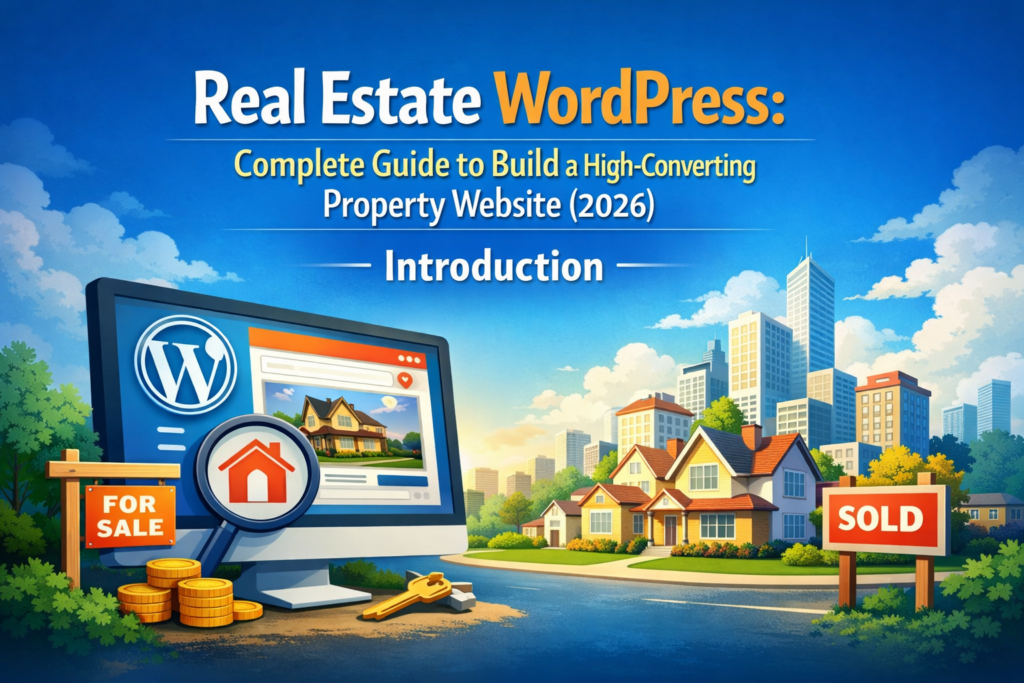
Introduction
Let’s be real for a second—most real estate websites don’t fail because of design. They fail because they don’t generate leads.
And in 2026, that’s a serious problem.
People are no longer calling brokers randomly or walking into offices. They search, compare, scroll, and decide—all online. If your website doesn’t convince them in those few minutes, they’re gone… probably to your competitor.
That’s exactly where a properly built WordPress real estate website makes a difference.
Not just a “nice-looking site”… but something that actually works like a lead machine.
So what exactly is a real estate WordPress website?
In simple language, it’s your online property showroom—but smarter.
Instead of just listing properties, it helps people:
- find what they want faster
- trust you quicker
- and most importantly… contact you
A good one doesn’t just show properties. It quietly pushes visitors toward taking action.
Why almost everyone is choosing WordPress now
I’ve seen agencies spend lakhs on custom websites… and still struggle.
At the same time, some agents using WordPress are generating consistent leads.
Why?
Because WordPress keeps things practical.
You don’t need to depend on a developer every time you want to:
- add a new property
- update pricing
- create a new landing page
You can literally handle most of it yourself.
And from an SEO point of view, it already gives you a solid base. Google understands WordPress sites well—which helps when you’re trying to rank for terms related to real estate.
The part most people get wrong (features that actually matter)
Here’s where most websites mess up—they focus on design, not usability.
Let me simplify what actually matters:
1. Property search should feel effortless
If a user has to struggle to find a property, they won’t try harder… they’ll just leave.
Filters like location, price, and property type should be smooth and fast. No confusion.
2. If you don’t capture leads, nothing else matters
This is the biggest mistake I see again and again.
People spend money on design… but forget forms.
Every property page should give users an easy way to:
- ask questions
- schedule a visit
- request details
If you make them “look” for contact options, you’ve already lost them.
3. Mobile experience is not optional anymore
Most of your traffic is coming from mobile. Not desktop.
If your site:
- loads slowly
- looks messy
- or is hard to navigate
people won’t stay.
Simple as that.
4. SEO is what brings people in the first place
Without SEO, your website is like a shop in the middle of nowhere.
You need visibility.
That means:
- using the right keywords naturally
- writing useful content
- and targeting specific locations
If you skip this, even the best website won’t get traffic.
Tools that actually make your life easier
You don’t need 50 plugins. Just the right ones.
For design, Elementor works well if you want flexibility.
For SEO, tools like Rank Math or Yoast help—but only if you use them properly.
And for listings, a good property plugin can save hours of manual work.
That’s it. Keep it simple.
Let’s talk about leads (because that’s the real goal)
Traffic is nice. Leads are better.
Here are a few things that actually work (not theory):
- Add a simple form on every property page
- Use WhatsApp—people respond faster there
- Create pages for specific locations (this works really well for SEO)
- Offer something useful like a brochure or price list
Also, one small trick—exit popups.
They feel annoying, but they work.
SEO in 2026 (what’s actually working)
Google has changed a lot, but one thing is still the same:
It rewards useful content.
Not keyword stuffing. Not tricks.
Just content that actually helps.
If you:
- answer real questions
- focus on specific locations
- and keep updating your site
you’ll start seeing results.
Mistakes that silently kill your website
Most people don’t even realize they’re doing this:
- No proper call-to-action
- Slow website speed
- Ignoring mobile users
- No clear SEO strategy
Fix just these, and you’ll already be ahead of most competitors.
Final thought
A real estate website is not just about being online anymore.
It’s about building something that:
- brings traffic
- builds trust
- and converts visitors into actual clients
WordPress just happens to be the easiest and most practical way to do that right now.